
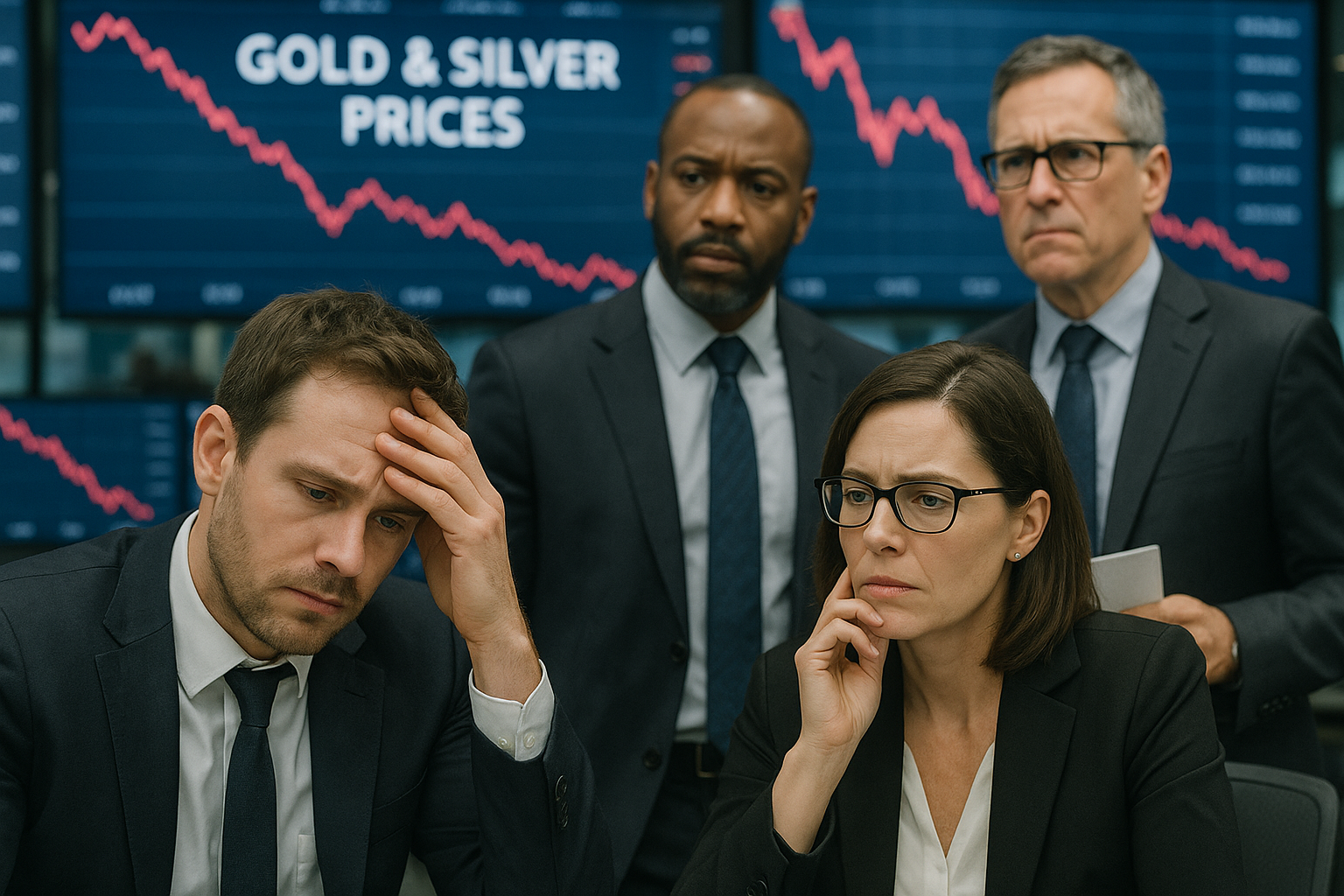
Gold and silver prices experienced a dramatic pullback this week as the red-hot momentum trade that defined early 2026 showed signs of cooling. After months of relentless gains that pushed gold above $5,400 per ounce and silver to $120 per ounce, both metals are now facing their sharpest correction of the year.
Sharp Declines Across Precious Metals
Gold was trading at approximately $5,161 per ounce on March 3, 2026, marking a decline of $177 or 3.32% from the previous session. The yellow metal dropped as much as 5.5% from its intraday highs, briefly falling below $5,100 per ounce for the first time since February 19.
Silver took an even harder hit, falling more than 8% to $81.23 per ounce in futures trading. This represents a dramatic decline from the metal's recent peak of $120 per ounce, though prices remain up more than $50 compared to one year ago.
Despite the selloff, gold is still up over 16% year-to-date and has gained an extraordinary 77% compared to March 2025, when prices hovered around $2,917 per ounce.
Experts Remain Bullish Long-Term
While the correction has rattled some investors, market analysts suggest the pullback may be healthy for the precious metals market.
Thomas Winmill of Midas Funds predicts gold will exceed $5,500 per ounce in the near term, driven primarily by central bank demand as global institutions continue to diversify away from U.S. dollar assets.
Darius Dale of 42 Macro points to favorable macro conditions, noting that global liquidity is trending higher while the U.S. dollar outlook continues to soften.
However, not all analysts are surprised by the sudden reversal. Hiren Chandaria of Monetary Metals warned that a steep pullback was possible, though he expects any corrections to be relatively short-lived given the underlying fundamentals.
Silver's Wild Ride
Silver has proven to be particularly volatile, amplifying gold's movements in both directions. James Cordier of OptionSpreakers.com suggests that silver prices should consolidate below $100 until new fundamentals emerge to drive the next leg higher.
The white metal's dual role as both a precious metal and an industrial commodity makes it especially sensitive to shifts in market sentiment and economic outlook.
Federal Reserve Holds Steady
The precious metals market is also watching Federal Reserve policy closely. According to CME Group data, 95.6% of market participants expect the Fed to maintain interest rates at the current 3.50-3.75% range at their March meeting, with only a 4.4% probability of a cut to 3.25-3.50%.
Lower interest rates typically benefit gold by reducing the opportunity cost of holding non-yielding assets, while a weaker dollar makes precious metals more attractive to international buyers.
Investment Considerations
Financial experts continue to recommend that investors allocate only 5-10% of their portfolios to precious metals. Rather than attempting to time short-term price movements, analysts advise focusing on gold and silver as long-term stores of value and portfolio diversifiers.
With geopolitical uncertainty persisting and central banks around the world continuing to accumulate gold reserves, many analysts remain confident that bullion could eventually top $6,000 per ounce, even as near-term volatility shakes out speculative positions.
Sources: CBS News, Fortune, CNBC