
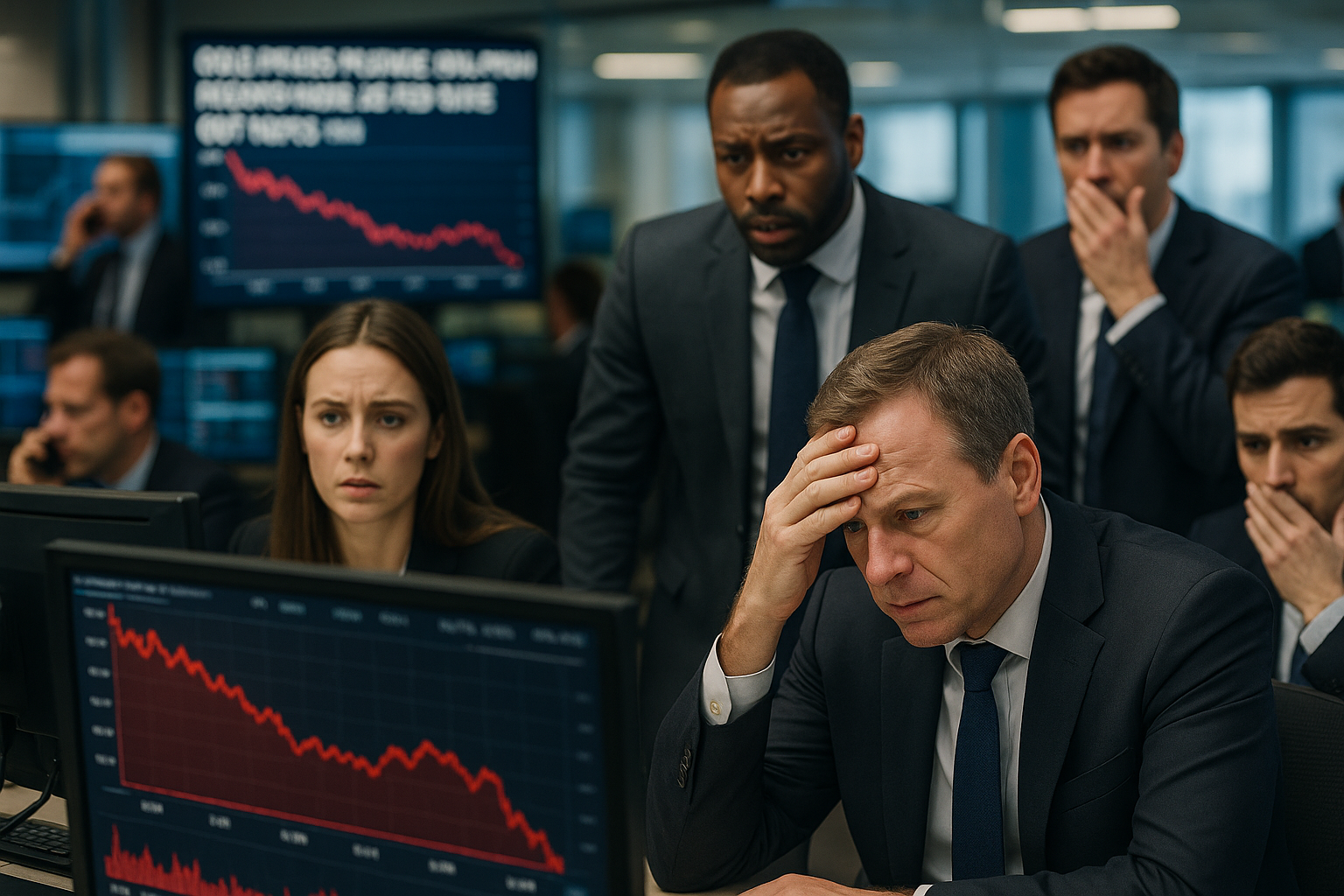
Gold's Sharp Retreat from Record Territory
Gold prices have fallen sharply from their January highs, with the precious metal trading at $4,433.53 per ounce as of March 27, 2026, according to Priority Gold. This represents a decline of more than 20% from the all-time high of $5,589.38 per ounce reached earlier this year.
The correction marks one of the steepest monthly declines in over a decade, catching many investors off guard after gold's spectacular 2025 rally—the strongest annual performance since 1979.
Federal Reserve Policy Takes Center Stage
The primary driver behind gold's retreat isn't geopolitical tension, but rather shifting expectations around Federal Reserve monetary policy. Following the Fed's decision to hold rates steady at its March meeting while projecting only one rate cut for 2026, markets have been forced to recalibrate.
"Gold is not responding to war. Gold is simply responding to the fact that the Federal Reserve might not lower interest rates as anticipated," said Alex Ebkarian, co-founder of Allegiance Gold.
The Fed's cautious stance comes amid renewed inflation concerns, particularly following disruptions to energy supplies through the Strait of Hormuz. With oil prices surging past $100 per barrel for the first time since 2022, inflation expectations have risen sharply, limiting the central bank's flexibility to ease monetary policy.
The Geopolitical-Inflation Paradox
In a twist that has puzzled some market observers, ongoing geopolitical tensions have actually worked against gold rather than supporting it. While conflicts typically drive safe-haven demand for precious metals, the associated oil price shock has heightened inflation expectations.
This has prompted markets to price out Federal Reserve rate cuts, strengthening the U.S. dollar—which has historically weighed on gold prices. The dollar index has climbed near 99.3, increasing the opportunity cost of holding non-yielding assets like gold.
Gold-backed ETFs have experienced net outflows as institutional investors reassess rate-cut timelines and rotate into assets that benefit from higher-for-longer interest rates.
Technical Picture Shows Oversold Conditions
From a technical standpoint, gold appears stretched to the downside. The 14-day Relative Strength Index has fallen to 27.6, firmly in oversold territory. Key support sits at the 200-day simple moving average around $4,096, while resistance looms at the 100-day SMA near $4,609.
Recent trading has seen significant volatility, with intraday swings ranging from $4,130 to $4,498 in recent sessions.
Wall Street Remains Bullish Long-Term
Despite the near-term pain, major Wall Street institutions maintain optimistic year-end price targets. J.P. Morgan leads the pack with a $6,300 per ounce forecast, while UBS projects $6,200. Deutsche Bank and Société Générale both target $6,000, with Goldman Sachs at $5,400 and Bank of America at $5,000.
J.P. Morgan's Natasha Kaneva offered a bullish perspective: "While this rally in gold has not, and will not, be linear, we believe the trends driving this rebasing higher in gold prices are not exhausted. The long-term trend of official reserve and investor diversification into gold has further to run."
Silver Follows Gold Lower
Silver has experienced an even steeper decline, trading at just $67.73 per ounce—down from over $100 in January. The white metal's more pronounced volatility has amplified losses relative to gold during this correction phase.
What Investors Should Watch
For those considering precious metals, the current correction may present opportunities. However, experts caution that dollar-yield dynamics remain the key variables to monitor. If inflation moderates and the Fed signals renewed openness to rate cuts, gold could quickly recover lost ground.
Until then, investors should expect continued volatility as markets navigate the tension between geopolitical uncertainty and inflation-fighting monetary policy.
Sources: CBS News, Capital.com, Priority Gold, J.P. Morgan Research, Allegiance Gold