
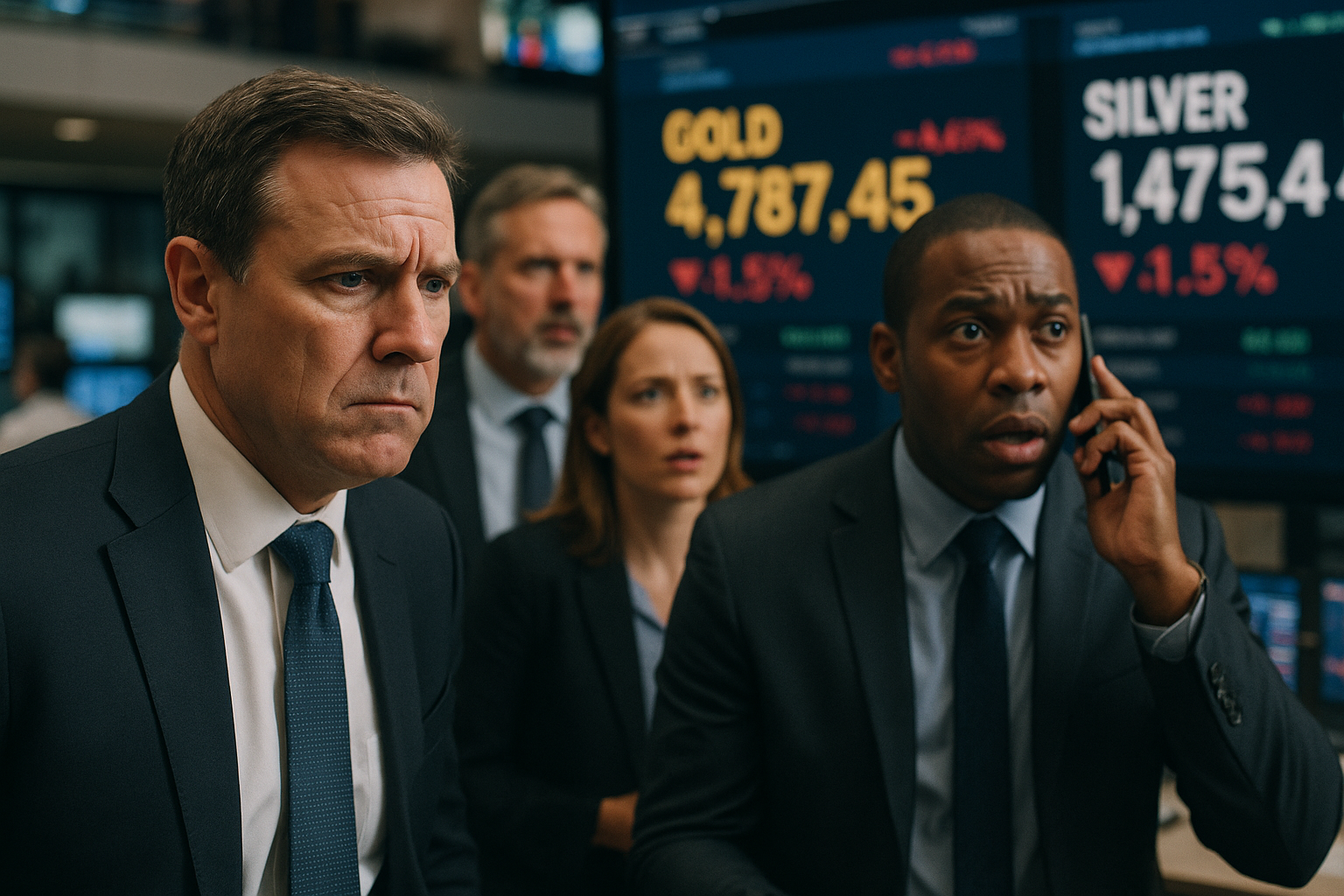
Gold Falls Below $4,800 as Dollar Gains
Gold prices retreated to $4,782.14 per ounce on April 21, 2026, declining 0.81% as a strengthening U.S. dollar weighed on precious metals. The pullback comes after months of gains that pushed the yellow metal to record highs earlier this year.
Despite the recent weakness, gold remains up 8.48% over the past month and has surged an impressive 43.33% compared to the same time last year. The metal continues to hold above $4,700 as investors weigh geopolitical developments and Federal Reserve policy expectations.
Silver Posts Steep 4% Decline
Silver experienced an even sharper pullback, falling to $76.55 per ounce on April 21—a decline of 3.95% from the previous session. The white metal touched its lowest level in approximately one week as traders repositioned amid uncertainty surrounding U.S.-Iran diplomatic negotiations.
The sell-off represents one of silver's steepest single-day declines this year, though the metal's longer-term performance remains remarkably strong. Silver has gained 10.74% over the past month and has more than doubled year-over-year, posting a stunning 135.47% increase compared to April 2025.
Dollar Strengthens on Geopolitical Uncertainty
The precious metals retreat coincided with renewed dollar strength as markets assessed the progress of U.S.-Iran talks. President Donald Trump recently extended a ceasefire with Iran, with negotiations moving toward a second round of peace discussions.
The Middle East conflict has triggered what analysts describe as a historic energy supply shock that has heightened inflationary risks and raised the likelihood of central bank rate adjustments. These dynamics have created headwinds for gold, which remains down more than 8% since the Iran war began.
Silver Market Deficit Extends to Sixth Year
Despite the short-term price pressure, silver's fundamental outlook remains supported by persistent supply constraints. According to the latest Silver Institute report, the 2026 market deficit is projected at approximately 46.3 million ounces—a 15% increase year-over-year and the sixth consecutive annual deficit.
The ongoing supply-demand imbalance continues to underpin silver prices even as short-term volatility increases. The gold-to-silver ratio widened to 61.1, reflecting silver's heightened sensitivity to both industrial demand concerns and monetary market dynamics.
Analysts Expect Continued Volatility
Market observers anticipate gold will remain volatile within a broad trading range of $4,300 to $5,000 in the near term. Price action continues to be driven by a combination of macroeconomic factors and geopolitical developments.
Financial advisor James Taska noted in Fortune that investors considering gold exposure may want to evaluate "paper gold" in ETF form, which he described as "much easier to rebalance" compared to physical holdings with potentially variable bid-ask spreads.
Long-Term Investment Case Remains Intact
Despite the recent pullback, many analysts maintain a constructive outlook on precious metals. Gold has risen over 25% since the start of 2025, fueled by ongoing inflation concerns and economic uncertainty. Experts continue to view this as a favorable environment for portfolio diversification with gold as a hedge against inflation and market volatility.
Platinum traded at $2,073 per ounce and palladium at $1,542 per ounce as of April 20, according to Fortune's precious metals tracking data.
Sources: Fortune, Trading Economics, Silver Institute, Goodreturns