
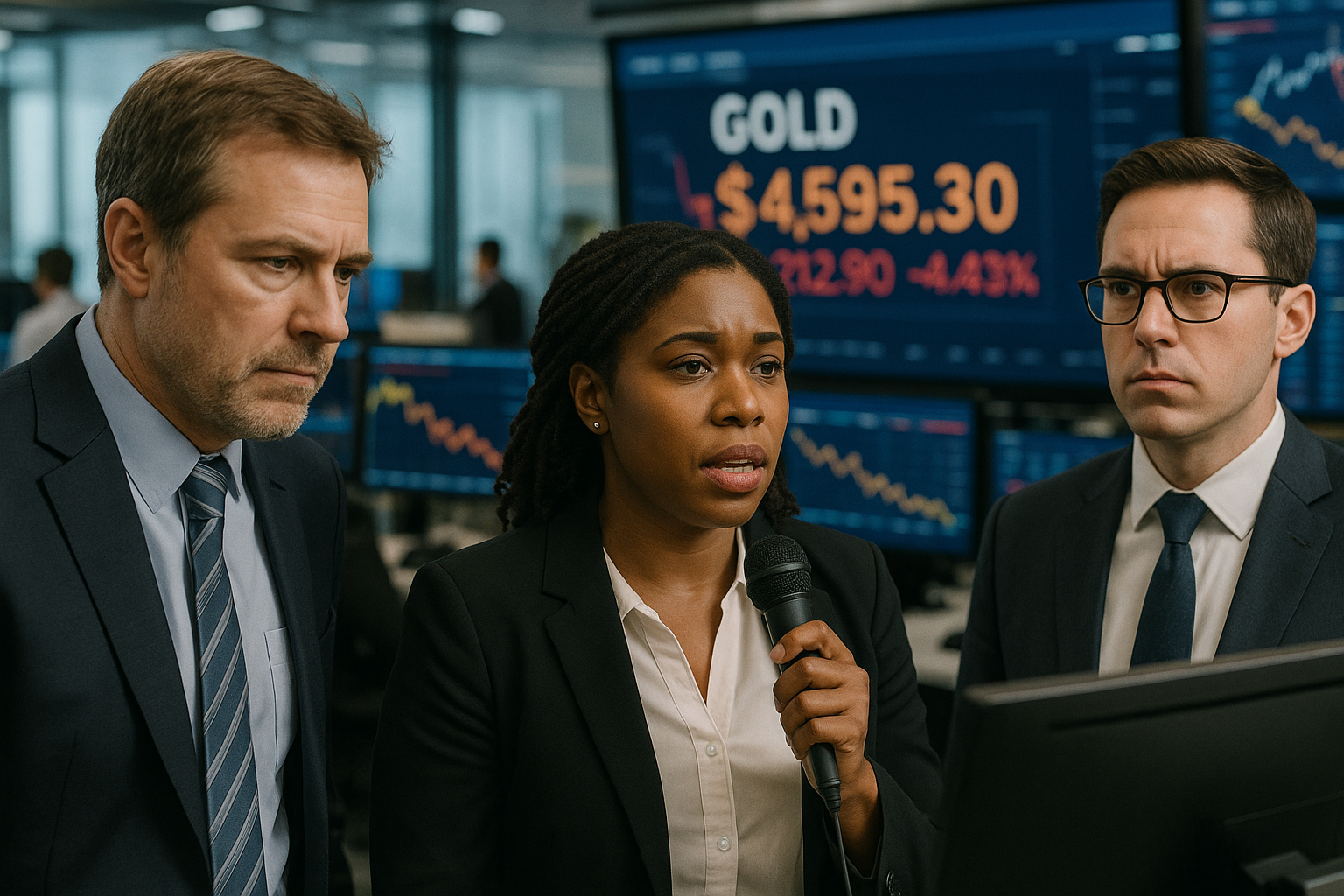
Precious metals retreated sharply on Tuesday as investors digested fresh diplomatic signals between Washington and Tehran and braced for a hawkish drumbeat from upcoming Federal Reserve communications. Gold fell to $4,585.95 per troy ounce, down 2.08% from the previous session, while silver sank 2.95% to $73.26 per ounce — both metals giving back ground after a torrid run earlier this year.
A Two-Day Reversal in the Bullion Trade
The pullback marks a stark reversal from just one day earlier, when gold was trading at $4,702 per ounce. The decline pushed the yellow metal to its lowest level since late March. Despite the sell-off, gold remains up roughly 38% year-over-year and 1.57% over the past month, while silver — the bigger story of 2026 — is still up an extraordinary 122% from a year ago, even after Tuesday's drop from its mid-April peak near $79.76.
Profit-taking, a firmer dollar, and rising real yields all contributed to the move. But the immediate catalyst was geopolitical: a fresh proposal from Tehran, delivered through Pakistani mediators, offering to reopen the Strait of Hormuz in exchange for the US lifting its blockade. The proposal notably defers talks on Iran's nuclear program, and Washington is expected to respond with counteroffers in the days ahead.
Oil, Inflation, and the Safe-Haven Bid
The Iran headlines have whipsawed commodity markets all month. On April 8, gold surged 3% to $4,850 and silver jumped nearly 7% to $77 after the US and Iran announced a two-week ceasefire that briefly sent oil below $100 per barrel. With talks now stalling again, energy prices have rebounded, reigniting inflation worries and pushing traders to reprice the path of monetary policy.
Higher-for-longer rate expectations are a particular headwind for non-yielding bullion. As one market summary noted, the recent decline reflects "dollar strength, rising yields, and profit-taking after a strong rally" — a textbook unwind of the haven trade as the immediate war premium fades.
Fed Transition Looms Large
Behind the day-to-day volatility sits a much larger question: who will succeed Federal Reserve Chair Jerome Powell when his term expires in May 2026. Confirmation hearings have struck a notably hawkish tone, dampening the rate-cut optimism that powered metals to record highs earlier this year.
According to analysts, the leadership transition could be decisive for the bullion trade. A more dovish successor would likely accelerate the so-called "debasement trade," while a hawkish appointment could keep real yields elevated and temporarily cool the rally.
Wall Street Still Sees Higher Prices Ahead
Despite Tuesday's weakness, sell-side conviction remains firmly bullish. J.P. Morgan Global Research expects gold to push toward $5,000 per ounce by the fourth quarter of 2026, with $6,000 a longer-term possibility. Citi strategists led by Kenny Hu recently raised their short-term gold target to $5,000, citing "heightened geopolitical risks, ongoing physical market shortages, and renewed uncertainty on Fed independence."
Silver's outlook is even more aggressive in some quarters. Goldman Sachs has projected an average price of $85 to $100 per ounce for 2026, framing the metal as the primary strategic beneficiary of the green-transition supply squeeze.
Central bank buying remains a structural pillar beneath the market. Per CME Group, official-sector activity has shifted from sporadic purchases to "consistent accumulation," following heavy net buying in 2024 and 2025.
The Setup From Here
For now, traders are caught between two opposing forces: a fading war premium pulling prices lower, and persistent structural demand — from central banks, industrial users, and inflation-wary investors — providing a floor. With Fed leadership unsettled and Iran negotiations live, expect the volatility seen Tuesday to remain a feature, not a bug, of the precious-metals tape.
Sources: Fortune ("Current price of gold" and "Current price of silver" daily reports for April 27–28, 2026), Trading Economics commodity data, Investing News Network ("Precious Metals Price Update"), J.P. Morgan Global Research, CME Group ("Precious Metals Outlook 2026").