
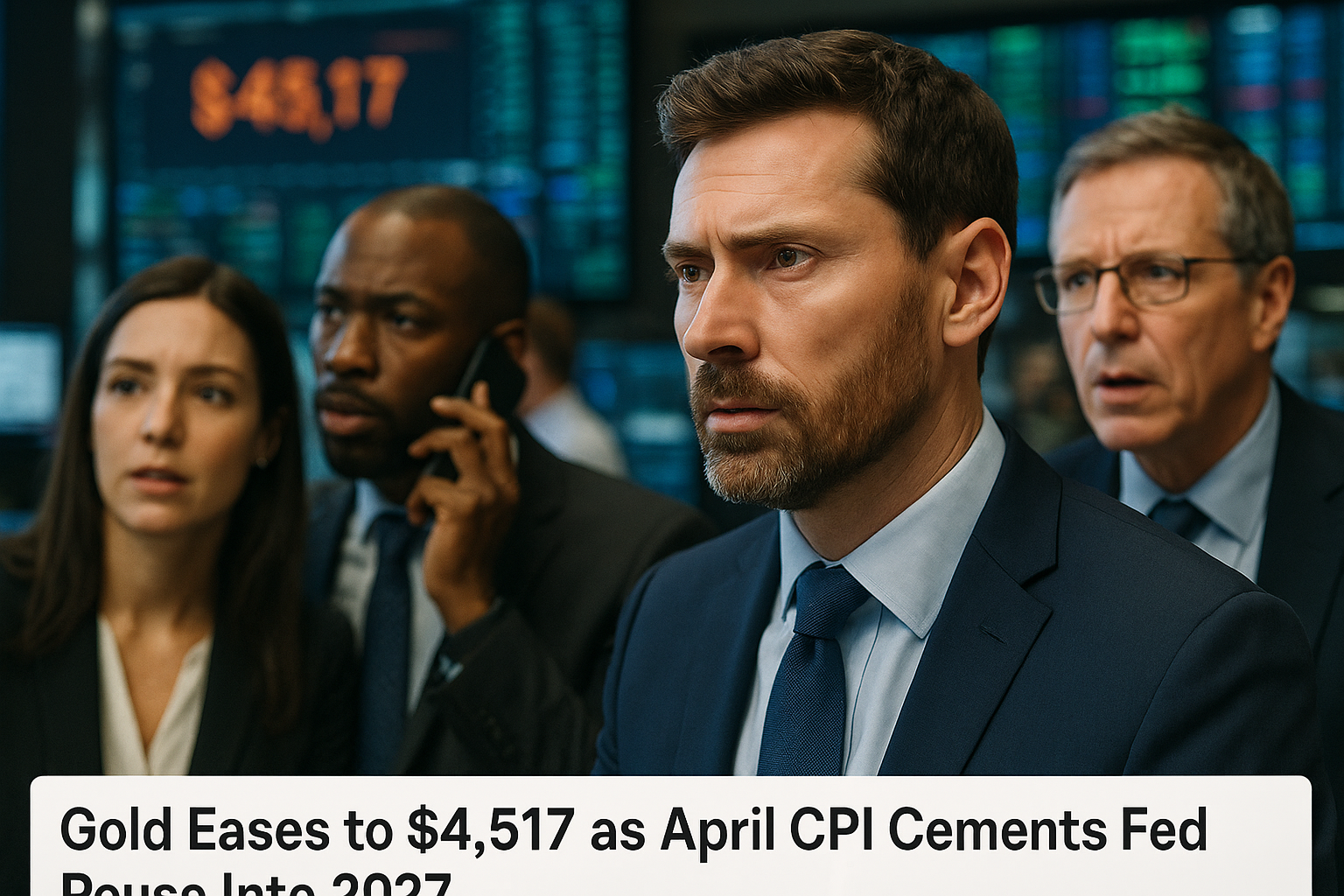
Gold opened June on the back foot, with spot bullion trading at $4,517.37 an ounce at 9:00 a.m. ET Monday, a slight decline from Friday's $4,523.29 print, according to CNBC's Gold/US Dollar Spot Price. The yellow metal remains on track for a 0.8% monthly decline, pressured by inflation concerns and growing market conviction that the Federal Reserve will keep rates unchanged well into 2027.
Silver, by contrast, ground higher. The white metal rose 0.53% to $75.64 an ounce in early New York trading, building on a 4.03% monthly gain and an extraordinary 117.61% year-over-year advance. The divergence captures a market that is now treating silver less as gold's understudy and more as its own structural story.
Inflation Reshapes the Rate Path
The defining catalyst remains April's U.S. inflation print, which showed the fastest monthly increase in three years. That single data point has effectively reset trader expectations around the Federal Reserve's policy trajectory, pushing the consensus for the first cut deep into 2027 territory.
For gold, the implications cut both ways. Higher-for-longer rates raise the opportunity cost of holding a non-yielding asset, a classic headwind that has capped rallies through May. But the same inflation that is keeping the Fed sidelined is also part of the longer-term thesis that has carried bullion up roughly 34% year-over-year and to a record $5,602.22 per troy ounce, set on January 28, 2026.
Iran Headlines Still Drive Day-to-Day Moves
Geopolitics remains the dominant intraday variable. Gold climbed for a second straight session to $4,580 an ounce on Friday after reports that Washington and Tehran may extend their cease-fire, only to give back ground as the rally collided with the firmer dollar that inflation expectations have fueled.
Even with a possible diplomatic off-ramp, traders are reluctant to fade the geopolitical premium entirely. Disruptions to regional shipping and energy infrastructure could keep oil prices elevated, a dynamic that feeds back into inflation expectations and reinforces the Fed's cautious posture. That feedback loop — Iran tension, sticky oil, sticky inflation, sticky rates — is the macro spine that bulls and bears are both trading around.
Silver's Structural Bid
While gold consolidates, silver continues to attract a different kind of buyer. J.P. Morgan Global Research projects silver will average $81 an ounce in 2026, more than double its 2025 average. The bank's call reflects what analysts increasingly describe as a structural mismatch between physical supply and industrial demand, particularly from the solar and electrification end markets.
Independent forecasts run wider. One analyst sees silver trading between $72 and $88 in June, with a base case of $80 to $85. Another, identified as Elliott in market commentary, places the range as wide as $60 to $100, with the bulk of the action between $70 and $90. The dispersion itself tells a story: positioning is heavy, conviction is high, but the path remains volatile.
Global Demand Dynamics
Physical demand offers a more mixed picture. Gold purchases in India, traditionally a swing buyer, remain weak as record-high local prices and elevated import duties have pushed retail consumers to the sidelines. In top consumer China, premiums have narrowed amid cautious market sentiment, suggesting wholesale demand is also feeling the price ceiling.
That softness in Asian physical buying is part of why gold has stalled in the $4,500 to $4,600 range despite supportive macro tailwinds. Until either prices reset lower or local affordability improves, the bid from the world's two largest gold-consuming markets is unlikely to provide the next leg higher.
What to Watch
The setup heading into June is unusually balanced. A confirmed extension of the U.S.-Iran cease-fire would likely pressure oil and the geopolitical premium, with gold and silver both vulnerable on a multi-day timeframe. A renewed flare-up, or a hotter-than-expected May CPI print later this month, would do the opposite — and likely accelerate the silver squeeze that JP Morgan and others are positioning for.
For now, the tape is telling a clear story: rates are on hold, inflation is sticky, and the metals are differentiating by use case rather than moving as a single bloc.
Sources: CNBC Select, Trading Economics, Yahoo Finance Personal Finance, Sunday Guardian, J.P. Morgan Global Research, Fortune.