
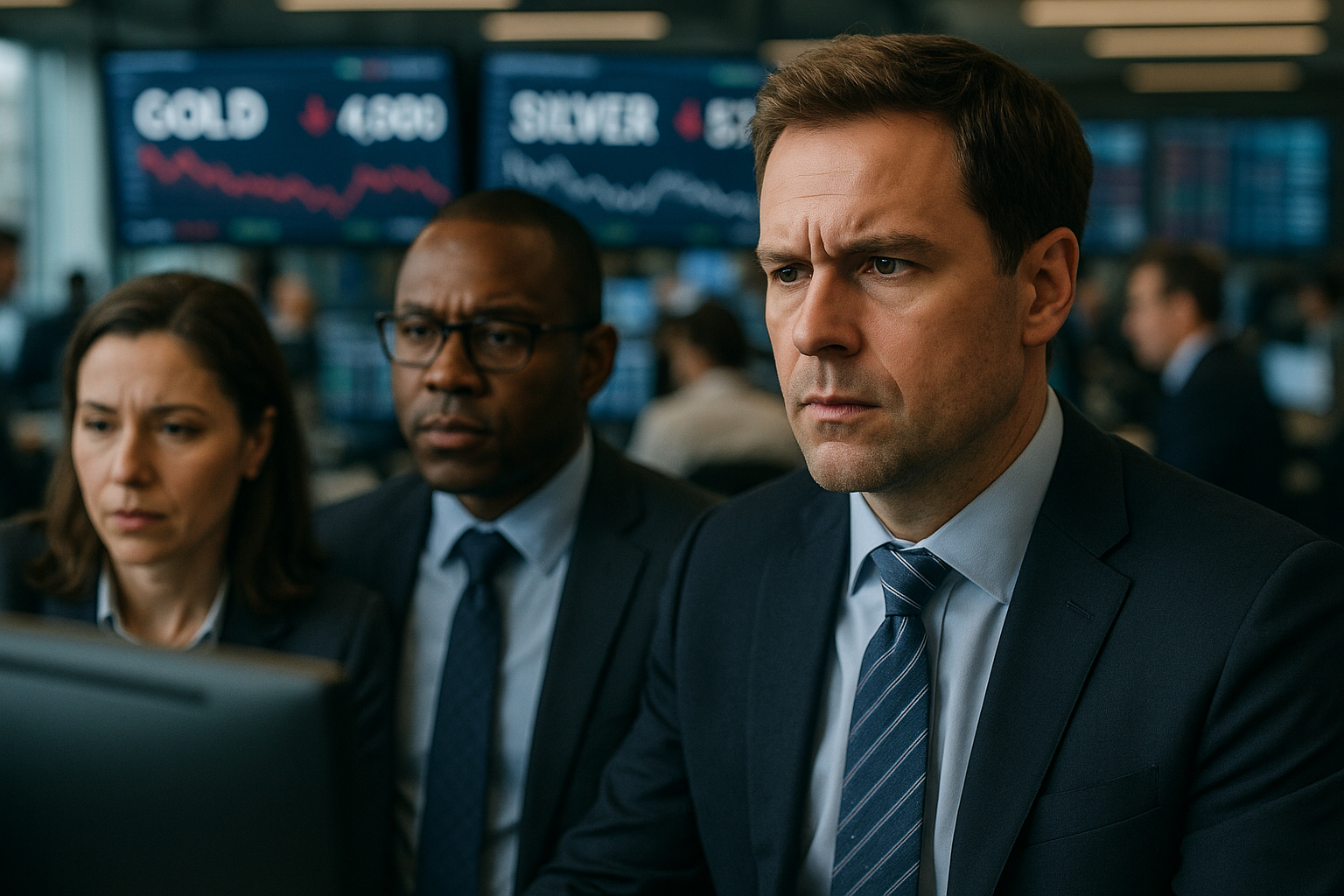
Precious metals extended their June slide on Thursday, with gold slipping toward the $4,000 mark and silver breaking below $57 an ounce, as a stronger U.S. dollar and rising expectations of a Federal Reserve rate hike continued to drain momentum from a market that ruled the first quarter of the year.
Gold Falls to $3,980 in Volatile Session
Spot gold traded near $3,980.16 per ounce in early U.S. trading, down 0.49% on the day, after touching $4,005 at the 8:45 a.m. Eastern Time fix. The yellow metal is now down roughly 5% year-to-date and nearly 20% below the January record high it reached before the outbreak of the conflict involving Iran.
The reversal marks a sharp turn for a commodity that had been one of 2026's standout assets. Bullion's pullback accelerated this month as the U.S. dollar surged to its highest level in more than a year against a basket of major currencies, making dollar-denominated commodities costlier for foreign buyers.
Silver Tumbles to Lowest Level Since November
Silver was hit even harder, falling 0.56% to $57.04 per ounce after dipping below $57 in intraday trading — the lowest level since November of last year. The white metal has shed 25.87% over the past month, although it remains 55.58% above where it traded a year ago.
"The correction in silver has been brutal but textbook," analysts at GoldSilver wrote in a recent outlook, noting that the metal's industrial demand profile makes it more sensitive than gold to shifts in growth and rate expectations.
Fed Hawkish Signals Drive the Move
Driving the selloff is a rapid repricing of Federal Reserve policy expectations. Traders now assign a roughly 68% probability to a Fed rate hike in September, up sharply from just 29% a week ago, according to futures-implied odds.
Fed Chair Kevin Warsh reinforced the hawkish tone at the central bank's last meeting, where policymakers held rates steady but signaled increasing support for tighter monetary policy. Warsh emphasized his commitment to bringing inflation under control, and markets are now pricing in the possibility of additional increases before year-end.
Higher interest rates are typically bearish for precious metals, which pay no yield and become less attractive relative to interest-bearing assets when rates rise.
Mixed Year-End Forecasts From Wall Street
Despite the recent weakness, major banks remain constructive on gold over the longer term. Year-end 2026 forecasts range from $4,900 at Goldman Sachs to roughly $6,000 at J.P. Morgan, with Wells Fargo projecting $6,100–$6,300, UBS at $5,500, and Bank of America also targeting $6,000.
Those bullish calls hinge on a combination of central bank buying, geopolitical risk premiums, and an eventual pivot back toward Fed easing — none of which appear imminent based on this week's price action.
What to Watch Next
With the U.S.-Iran ceasefire reducing some of the geopolitical premium that had been embedded in metals prices earlier this year, attention now shifts squarely to the U.S. economic calendar. Upcoming CPI and PCE inflation readings, along with Fed commentary, will likely determine whether the September hike materializes — and whether the precious metals correction extends or finds a floor.
For now, the dollar's strength and the Fed's hawkish drumbeat are firmly in control of the tape.
Sources: Fortune, Trading Economics, Yahoo Finance, Barchart, GoldSilver, J.P. Morgan Global Research