
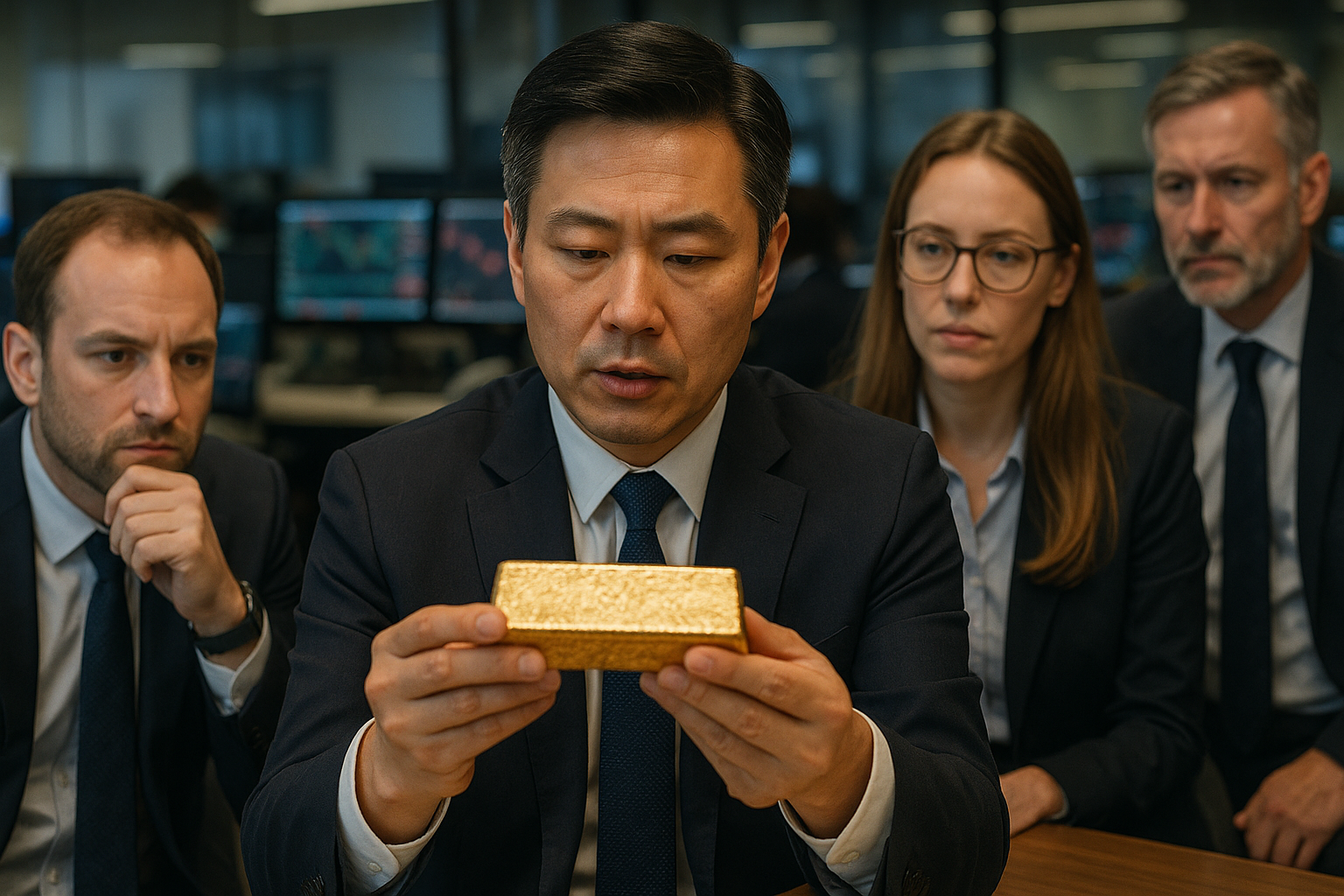
Two forces are pulling gold in opposite directions this month, and only one of them trades on the futures screen.
The People's Bank of China added 650,000 ounces to its gold reserves in August, lifting official holdings to 76.73 million ounces — roughly 2,386.6 tonnes. It was the 22nd consecutive month of buying, the longest documented run on record, and it topped July's 640,000-ounce purchase, which had itself been the largest single month since October 2023. The reported value of those reserves rose to $350.08 billion from $306.35 billion a month earlier, a jump driven far more by price than by tonnage.
Gold itself went the other way. Spot bullion traded near $4,404.98 an ounce Monday, September 7, down 0.62% on the day, according to Trading Economics. That followed a bruising Friday in which gold settled around $4,429, off 1.14%, and silver closed at $66.17, down 1.22%.
The Payrolls Shock That Reset the Curve
Friday's selloff had a single trigger. U.S. employers added 162,000 jobs in August, against consensus estimates clustered near 55,000. July's figure was revised up to a 23,000 gain. The unemployment rate held at 4.1%, and annual wage growth eased to 3.1%.
That combination — resilient hiring, no labor-market crack — lifted Treasury yields and the dollar and revived bets that the Federal Reserve tightens rather than eases at its September 15-16 meeting. Futures pricing has hovered in the 60% to 66% range for a 25-basis-point hike since Fed Chair Kevin Warsh spoke at Jackson Hole on August 28. The federal funds target has sat at 3.50%-3.75% since December 2025.
Warsh gave markets the language they needed. "While this summer's readings were better than expected, they do not tell me that underlying trends have meaningfully improved," he said of inflation. He went further: "We must be confident that underlying inflation is moving to our objective, clearly and at sufficient speed. Otherwise, we have work to do. That's our job, our mandate and our charge to keep."
Headline CPI held at 3.4% year over year in July, with core at 2.5%. The August report lands Friday, September 11 — four days before the FOMC convenes.
Official-Sector Demand Doesn't Read the Dot Plot
Higher policy rates raise the opportunity cost of holding a metal that pays no coupon, which is why gold sells off on strong jobs prints. Central bank reserve managers operate on a different clock.
The World Gold Council estimated net official-sector purchases of 244 tonnes in the first quarter of 2026, above both the prior quarter and the five-year average, and forecasts roughly 850 tonnes for the full year — close to last year's total. Its 2026 Central Bank Gold Reserves Survey found 89% of reserve managers expect global central bank gold holdings to rise over the next 12 months, with a record share planning to add to their own.
That demand is largely price-insensitive. It is a response to geopolitical risk, reserve diversification, and a smaller intended role for the dollar — not to the two-year yield.
What It Means for Investors
Gold is still up more than 25% since early 2025 and roughly $1,008 an ounce from a year ago. A hawkish September dot plot could extend the correction from the $4,510 high set last week. But the bid that carried the metal here has not gone anywhere, and it is not waiting on Friday's CPI print.
Sources: People's Bank of China reserve data via Bloomberg and Cryptobriefing; World Gold Council (Gold Demand Trends Q1 2026, 2026 Central Bank Gold Reserves Survey); Trading Economics; CNBC; Federal Reserve Board (Chairman Warsh, Jackson Hole keynote, August 28, 2026); U.S. Bureau of Labor Statistics; The Washington Post.