
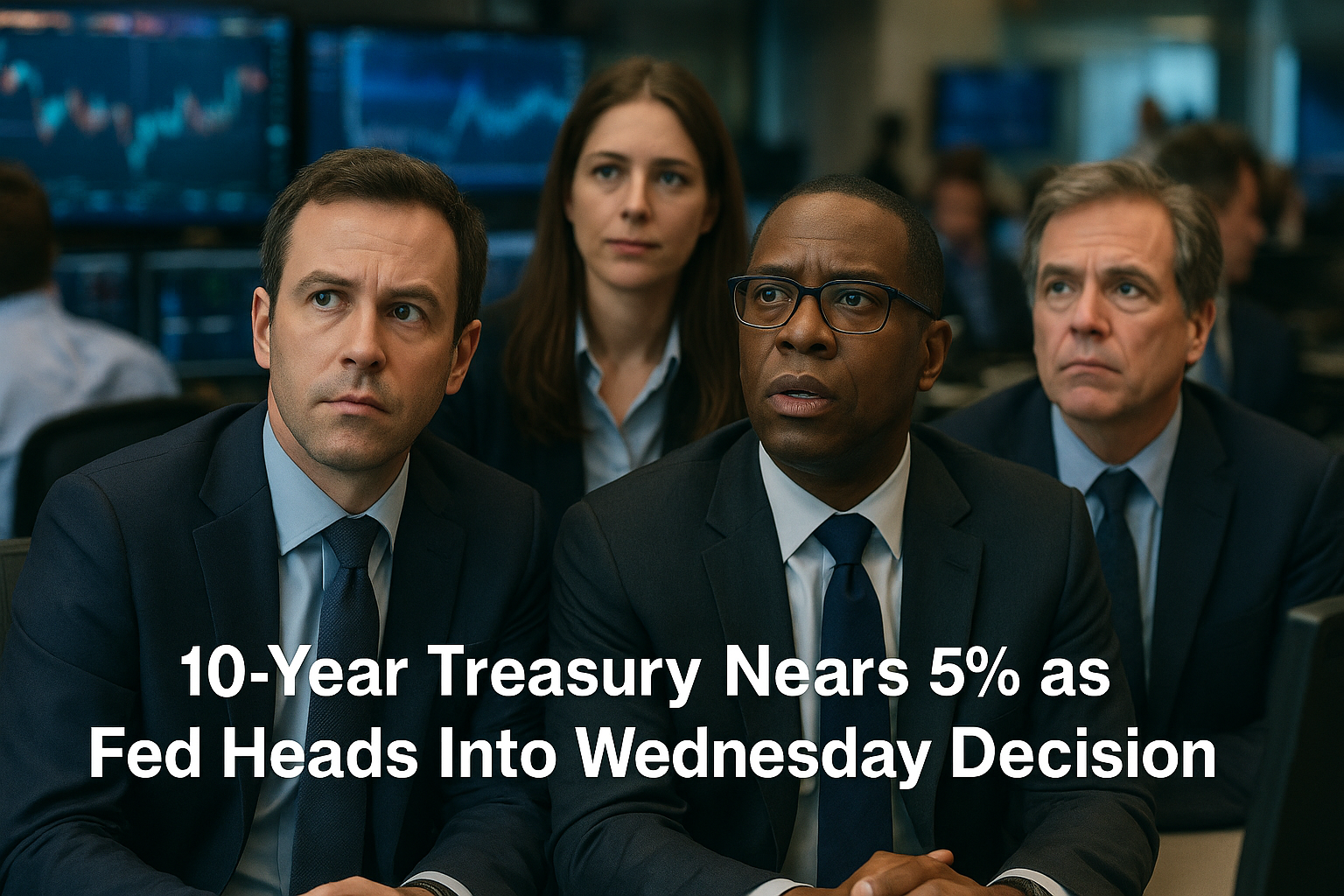
The bond market is about to test a number it has not crossed in nearly two decades, and it is doing so forty-eight hours before the Federal Reserve announces what markets expect to be another rate increase.
The yield on the 10-year Treasury note rose to 4.992% on Friday, its highest since October 2023, and was trading near 4.99% on Monday, up more than a basis point, according to CNBC. The benchmark climbed almost 20 basis points last week in what Bloomberg described as a global bond selloff. A move past 5.02% would put the 10-year at its highest level since July 2007 — the months immediately preceding the global financial crisis.
That historical echo is most of why the 5% handle carries the weight it does. The 10-year has rarely breached it in modern market memory, which turns an otherwise arbitrary round number into a psychological line that portfolio managers watch and headline writers wait for.
What Is Pushing Yields Up
Three forces are working in the same direction at once.
The first is oil. Brent crude settled near $104.60 a barrel on Friday after touching $107 on Thursday, when Houthi forces took the Yemeni port of Mokha. Crude above $100 feeds directly into inflation expectations, and August's Consumer Price Index — 0.4% on the month, 3.4% annually — already carried a heavy energy contribution.
The second is supply. The latest leg of the selloff reflects a supply-demand imbalance as Treasury and corporate issuance compete for the same pool of investor capital. Strategists at BMO Capital Markets wrote that a more active buyback program could limit selling pressure but "fails to address the prevailing fundamental drivers of the upward pressure on 10- and 30-year yields."
The third is the Fed itself. Traders put roughly 90% odds on a quarter-point increase at Wednesday's decision, which would lift the federal funds target range to 3.75%–4.00% from the 3.50%–3.75% band that has held all year.
A Split Committee
Chair Kevin Warsh set the tone at Jackson Hole, saying underlying inflation trends had not "meaningfully improved" and that the Fed still has "work to do." Before that speech, markets had priced nearly 70% odds of no change in September.
The committee is not unanimous. Fed Governor Christopher Waller has said he would be inclined to vote to hold at the current range. Molly Brooks, a U.S. rates strategist at TD Securities, had flagged ahead of the CPI release that a hotter print would boost expectations for both a September hike and further tightening beyond it.
Where the Pain Shows Up
The 10-year is the reference rate for mortgages, auto loans and corporate borrowing, which is why the level matters well outside the bond desk. Freddie Mac put the average 30-year fixed mortgage rate at 6.76% last week.
Analysts also point to a less obvious pressure point: the AI buildout, financed heavily with debt. If risk-free Treasuries yield 5%, corporate bonds have to compete, and higher funding costs change the arithmetic for companies already under investor scrutiny over capital-spending returns.
The broader read from strategists is that the driver matters more than the level. A yield climbing on strong growth is absorbable. One climbing on inflation, fiscal strain and term premium — which is the case being made now — is a different problem.
Around the Move
Equities rallied into the weekend, snapping a four-session losing streak. The S&P 500 rose 0.86% to 7,656.98, the Nasdaq Composite gained 0.96% to 26,333.04, and the Dow added 509.19 points, or 0.98%, to 52,573.29.
Gold has gone the other way, trading in a $4,348–$4,461 range and down nearly 1% last week — a third consecutive weekly loss, with higher real yields doing the damage. Silver sat near $64.39–$65.59. The dollar index held around 99.1.
Wednesday is not the only central bank event this week. Brazil's Copom decides the same day, the Bank of Japan meets September 17–18, and the Bank of England is expected to hold at 3.75% on September 19.
Sources: CNBC, Bloomberg, Rio Times Global Economy Briefing (September 14, 2026), Freddie Mac, CME Group FedWatch, Yahoo Finance