
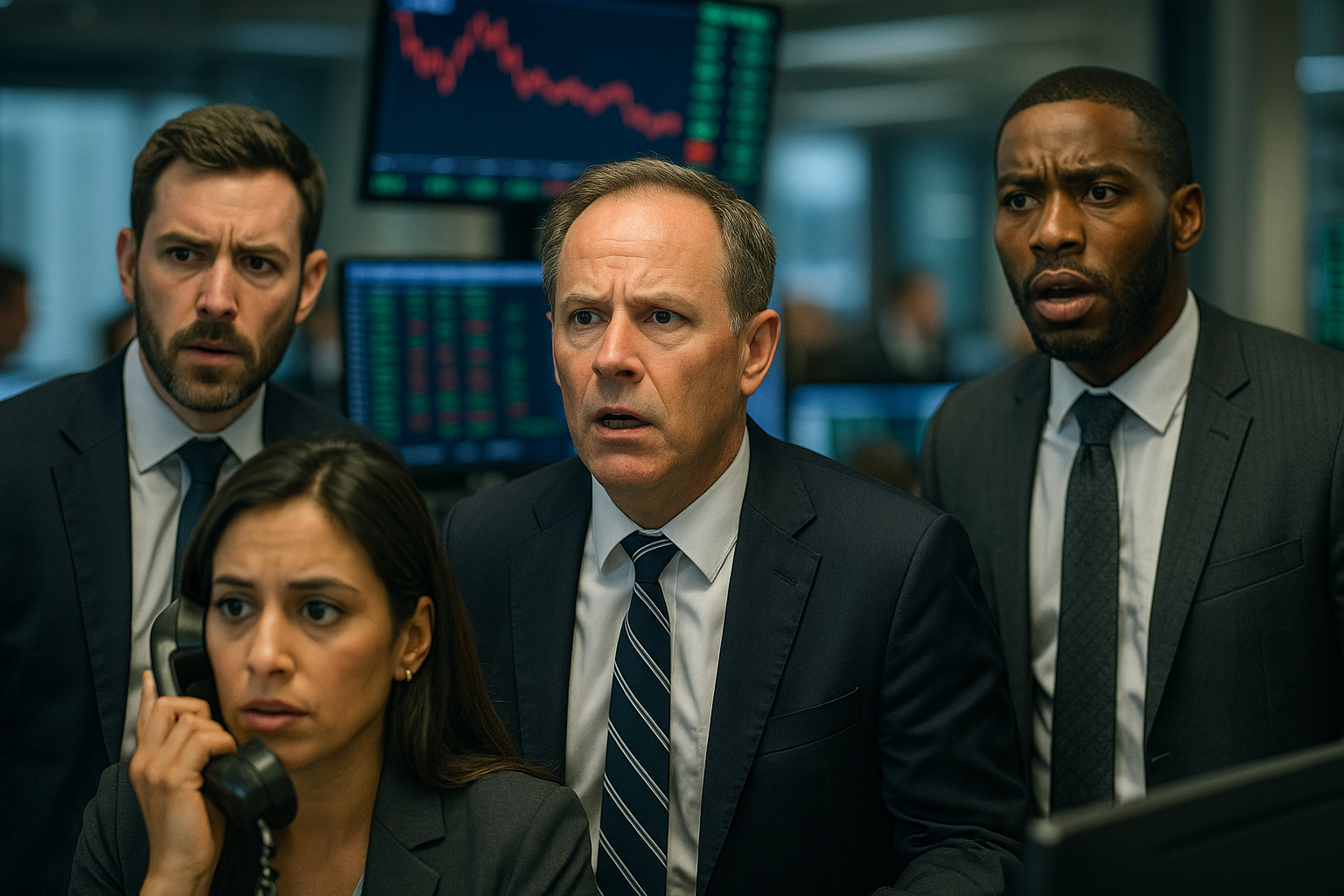
The 10-year Treasury yield crossed the line it had only flirted with, reaching 5.025% on Tuesday morning — its highest level since July 2007 — one day before the Federal Reserve is widely expected to raise interest rates for the first time in more than three years.
The move confirms what Monday's session only hinted at. The benchmark rose as high as 5.01% in New York morning hours on Monday before buyers emerged and erased the increase. Tuesday's advance of roughly four basis points pushed it decisively above the 2023 peak, taking out a level that had capped the market for nearly two decades.
The rest of the curve moved with it. The 30-year bond yielded 5.384%, the 2-year 4.68%, the 5-year 4.85% and the 7-year 4.93%.
Oil and Bonds Are Now the Same Trade
The more consequential development may not be the level at all, but what is driving it.
The one-month rolling correlation between front-month West Texas Intermediate crude and the 10-year Treasury yield has climbed to 0.96, according to BMO Capital Markets. That is the strongest positive relationship since June 2019, and before that October 2014. A reading that close to 1.0 means the two markets have effectively stopped trading as separate assets.
"The geopolitical drivers behind the price of oil and global inflation are so prominent," said Steve Sosnick of Interactive Brokers, describing the relationship as unusually tight.
The mechanism is straightforward and uncomfortable. Brent crude is holding firmly above $100 a barrel after attacks on Saudi infrastructure and continued disruption around the Strait of Hormuz, and it touched a session high past $109 on Monday. Every further leg higher in crude now transmits almost directly into inflation expectations, Treasury yields and borrowing costs. Market-priced inflation expectations sit near 2.38%, above the Fed's 2% target.
That correlation is not permanent — it could unwind quickly if Middle East tensions ease or if growth fears start to dominate. For now it means the Fed is setting policy against an inflation impulse it does not control.
A Near-Certain Hike
Traders are pricing more than a 92% chance of a quarter-point increase at the meeting that began Tuesday, with CME FedWatch readings running as high as 93%. That would be the first hike since July 2023 and would lift the target range to 3.75%–4.00%.
The committee arrives divided. July's decision to hold was a 9-3 vote, with three members dissenting in favor of an immediate quarter-point increase. New York Fed President John Williams has offered little reassurance: "There's no clear signs right now whether monetary policy currently is sufficient to make sure we bring inflation back to target in the next year or two."
Strategists do not see the selloff as finished. Steven Barrow, head of G10 strategy at Standard Bank in London, raised his 10-year forecast to 5.2% by year-end and 5.3% in the first quarter of 2027. Luis Alvarado, co-head of global fixed-income strategy at Wells Fargo Investment Institute, called the move "a little bit of a wake-up call that the real issues of why rates are moving higher are not really being addressed."
The Transmission to Households
The 10-year is the reference rate for mortgages and consumer credit, and the pass-through is already visible. Freddie Mac put the average 30-year fixed mortgage at 6.76% as of September 10, up from 6.71% a week earlier, with some daily surveys showing rates near 6.89% over the weekend.
The fiscal arithmetic compounds it. Total federal debt has passed $40 trillion, the deficit ran $1.8 trillion through the first seven months of fiscal 2026, and interest payments now consume roughly 15% of the federal budget — a bill that reprices upward with every basis point.
Elsewhere in Markets
Precious metals continued to slide under the weight of higher real yields. Gold fell 0.84% to $4,263.19 an ounce, hovering near five-week lows, while silver traded at $62.99, down $0.13 on the day.
The dollar climbed toward a two-week high, with the dollar index near 99.5 and gaining for a fifth consecutive session. Equities entered Tuesday on the back foot after the S&P 500 closed Monday at 7,619.98, down 0.48%, and the Dow shed 152.09 points to 52,421.20.
August retail sales land Wednesday at 8:30 a.m. Eastern, hours before the Fed's announcement. The Bank of Japan is expected to raise rates Friday, following a European Central Bank increase last week.
Sources: CNBC, Bloomberg, BMO Capital Markets, CME Group FedWatch, Semafor, Freddie Mac, Trading Economics, FXStreet