
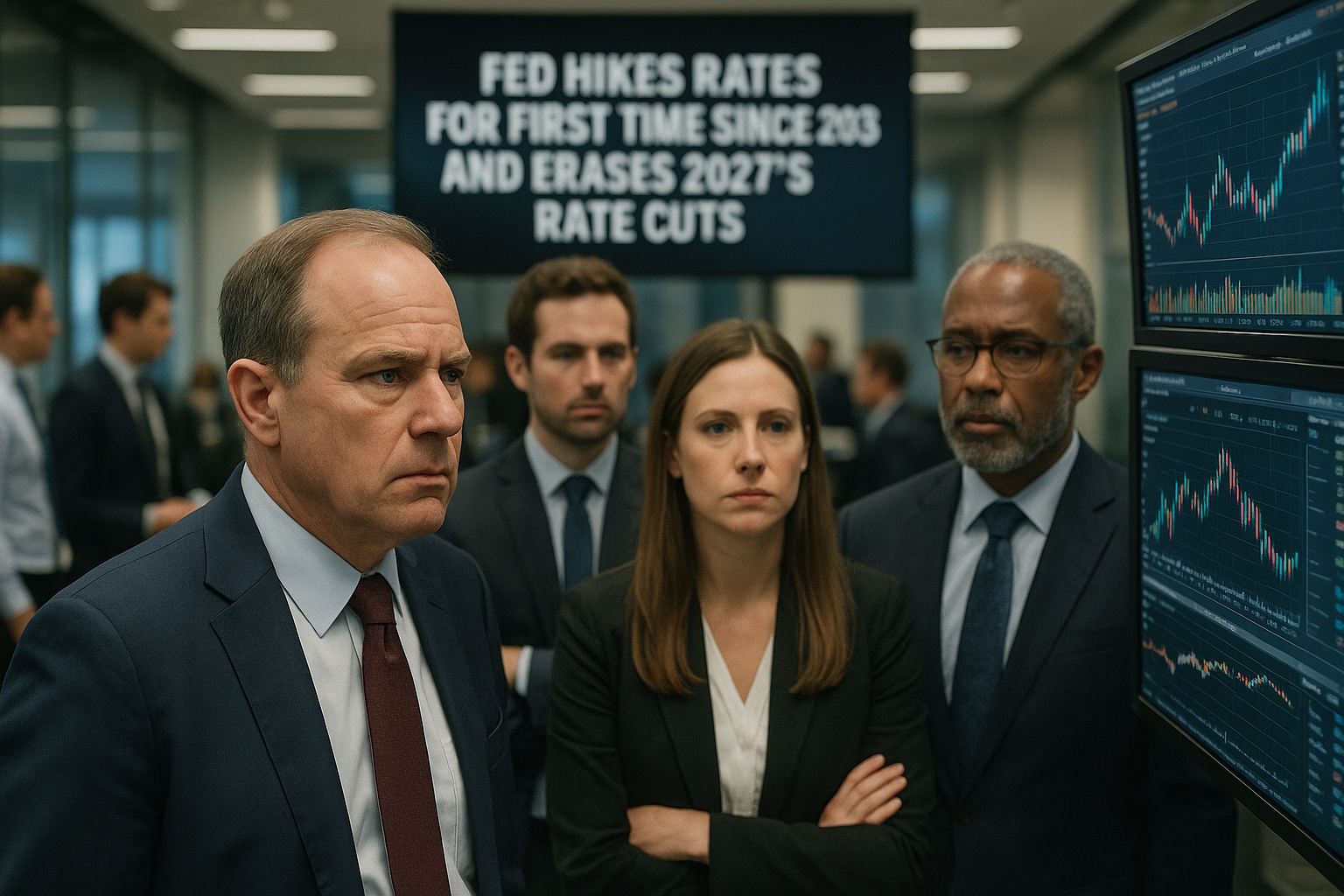
The Federal Open Market Committee raised the target range for the federal funds rate by a quarter point to 3.75%–4.00% on Wednesday, the first increase since 2023. The vote was unanimous, 12-0, with no dissents.
The hike itself was never the story. Futures had it better than 90% priced. The story was the Summary of Economic Projections released alongside it — and specifically what happened to 2027.
The 2027 Dot Moved 50 Basis Points
In June, the median FOMC participant projected the federal funds rate would end 2027 at 3.6%, comfortably below where it would peak. That implied the committee saw itself cutting next year.
Wednesday's projections put the 2027 median at 4.1% — identical to the 2026 median of 4.1%. The committee now expects one more quarter-point increase this year, and then nothing. No cuts in 2027 at all. The 2028 median sits at 3.9%, implying a single cut two years out, with 3.6% pencilled in for 2029.
The longer-run neutral rate estimate also drifted up, to 3.2% from 3.1% in June.
The rest of the projections explain the shift. Median PCE inflation for 2026 was revised up to 3.7% from 3.6%, and core PCE to 3.4% from 3.3%. But the more consequential revision was on the other side of the mandate: the median unemployment rate for 2026 dropped to 4.1% from 4.3% in June, with 4.1% now projected for 2027, 2028 and 2029 as well. Median GDP growth was nudged up to 2.3% for 2026 and 2.4% for 2027.
A labor market that no longer looks like it is loosening removes the main argument for patience.
Warsh Declines to Soften It
The statement said inflation "remains elevated" and that "today's policy action will support a timelier return to the Committee's 2 percent goal," while describing economic activity as "expanding at a solid pace."
Fed Chair Kevin Warsh was blunter at the press conference. "Our predominant focus is on the price stability side of our mandate," he said. "The plain fact is that inflation is too high and has been for too long."
Asked what would stop further tightening, Warsh set a high bar: "We must be confident that underlying inflation is moving to our objective, clearly and at sufficient speed." He rejected the premise that this requires a downturn — "I don't believe that we need to do harm to the labor markets to achieve our objective" — and waved off a question about his conversations with President Trump with "I've got nothing for you on the discussion with the president."
On tariffs and energy prices, Warsh drew a boundary: "We stay in our lane. We'll let people that do trade policy stay in their lane too." The Fed cannot move any single price, he said, but can "ensure that any change in relative prices don't broaden out."
Stocks Turned Down During the Presser
Equities were little changed on the decision itself and sold off as Warsh spoke. The Dow Jones Industrial Average closed at 51,462.14, down 630.97 points or 1.21%. The S&P 500 fell 33.57 points to 7,552.16, a 0.44% decline. The Nasdaq Composite finished essentially flat at 25,978.42, off 3.15 points.
The bond market's reaction was concentrated at the front end, which is where a repriced 2027 belongs. The 2-year Treasury yield rose about 5 basis points to 4.717%, erasing an earlier decline. The 10-year closed roughly unchanged at 5.008%, holding the 5% level it first touched this week for the first time since 2007.
Gold settled at $4,310.50 an ounce, down $22.30 or 0.51%.
Sources: Federal Reserve FOMC statement and Summary of Economic Projections (September 16, 2026); Yahoo Finance; CNBC; Kiplinger; Barchart.