
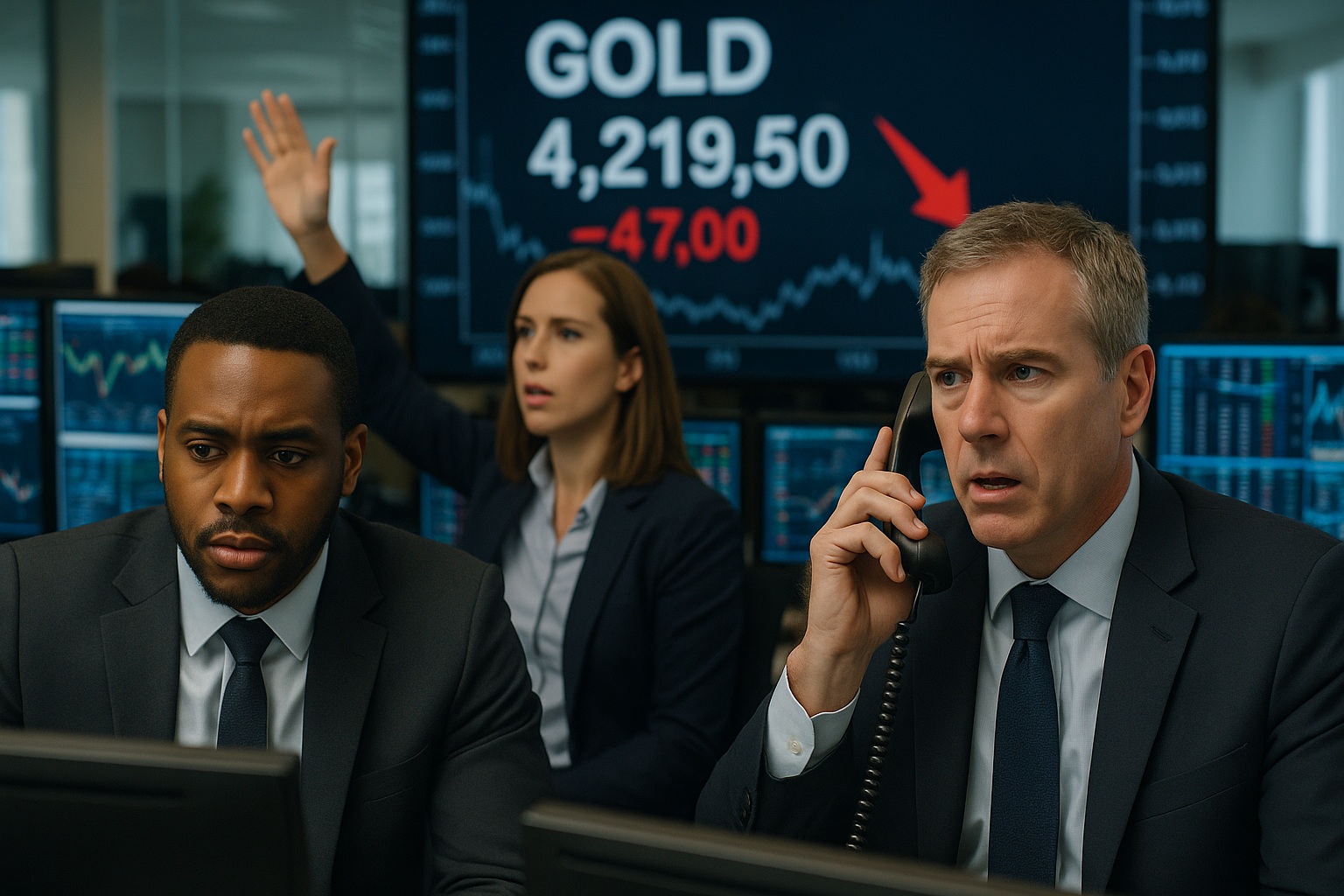
Gold is trading in a choppy range on Thursday as traders weigh an extended U.S.-Iran ceasefire against the risk that stalled peace talks reignite tensions across the Strait of Hormuz. Spot gold changed hands near $4,736 per ounce early in the U.S. session, down roughly $10 from Wednesday's close but still $1,448 higher than a year ago, according to Fortune's daily price tracker. Silver held near $78.50 per ounce after erasing modest intraday gains.
Ceasefire Extension Eases, But Does Not Eliminate, Risk
The pullback extends a pattern that has defined bullion trading since Tuesday, when gold briefly rallied after Washington extended its ceasefire with Tehran, only to pare gains as planned peace talks collapsed. CNBC reported Wednesday that gold firmed as lower oil prices eased fears of an inflation spike and prolonged high interest rates, while safe-haven flows rotated partly into the U.S. dollar rather than precious metals.
Iran has said it will not reopen the Strait of Hormuz while the U.S. Navy continues intercepting vessels, keeping a floor under safe-haven demand even as the ceasefire holds. FX Leaders noted that spot gold is "still refusing to budge below the $4,700 mark," with a potential breakout toward $4,780 if tensions re-escalate.
Silver's Outsized Year
Silver's move has been the more striking story. Prices have climbed more than 150% over the past year and are up more than 25% since the start of 2025, pushing the white metal to levels unseen in more than a decade. Analysts cite persistent inflation worries, industrial demand tied to the energy transition, and spillover bids from gold's record-setting run.
Gold's all-time high of $5,589.38 was set on January 28, 2026, meaning current prices sit roughly 13% below the peak. Many strategists view the slide not as a reversal but as consolidation inside a structural bull market.
Wall Street Still Sees Upside
Major banks remain broadly constructive. J.P. Morgan Global Research forecasts gold averaging $5,055 per ounce in the fourth quarter of 2026 and rising toward $5,400 by the end of 2027. The firm's head of Global Commodities Strategy said the bank expects "gold demand to push prices toward $5,000/oz by year-end 2026."
Year-end 2026 forecasts across the Street now span a wide band: Goldman Sachs sits at $5,400, while J.P. Morgan and Wells Fargo have published targets as high as $6,300. UBS trimmed its near-term outlook to $5,200 by June, citing a firmer dollar, rising oil, and a shift in rate expectations, but still looks for $5,900 by late 2026.
What To Watch Next
Traders will focus on three drivers into next week: any signal that U.S.-Iran peace talks resume, movement in the dollar index as Treasury yields reset, and the pace of central bank buying, which has underpinned gold since 2022. A decisive break above $4,780 would reopen the path toward $4,900, while a close below $4,700 could expose the $4,640 zone that capped last week's decline.
For now, the precious-metals complex remains a textbook example of cross-currents: a ceasefire that cools fear, geopolitical fragility that keeps hedgers engaged, and a dollar competing with gold for the safe-haven bid.
Sources: Fortune (daily gold and silver price trackers, April 20-23, 2026), CNBC ("Gold rises as oil weakens after U.S. extends ceasefire with Iran," April 22, 2026), FX Leaders ("Gold Price Rebounds to $4,730-$4,760 as US-Iran Ceasefire Extension Eases Tensions," April 23, 2026), J.P. Morgan Global Research gold price outlook.