
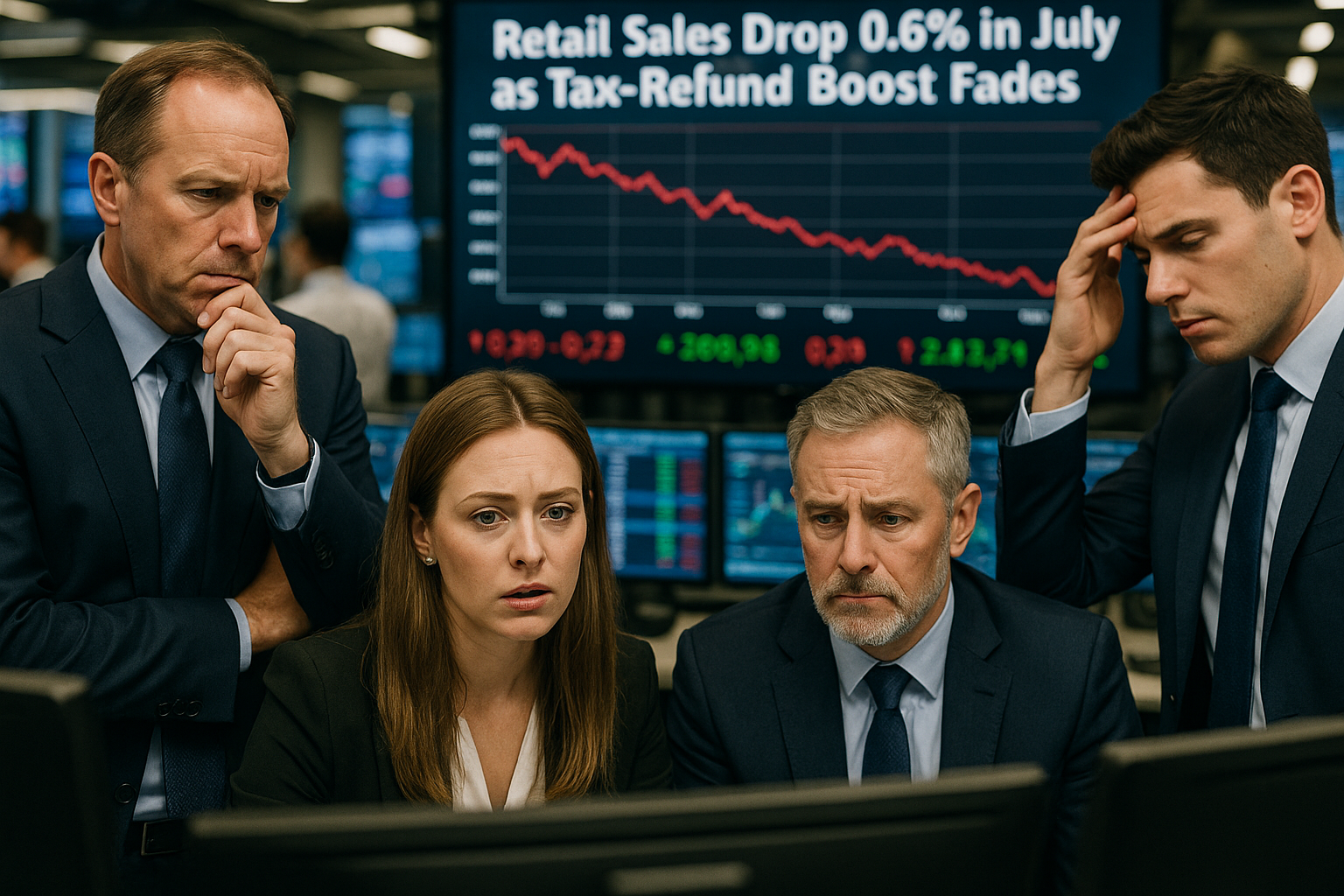
American consumers pulled back sharply last month. Retail and food services sales fell 0.6% in July to $763.6 billion, the Census Bureau reported Friday, reversing June's 0.2% gain and marking the steepest monthly decline since May 2025. Economists surveyed by Reuters had expected a 0.1% increase, with forecasts ranging from a 0.5% drop to a 0.7% gain.
The miss was broad enough to matter. The control group — which strips out autos, gasoline, building materials and food services, and feeds directly into GDP calculations — fell 0.4% against expectations for a 0.3% rise. June's control-group figure was revised down to 0.4% from 0.5%.
Where the Spending Stopped
Online retailers led the decline, with sales down 2.2%, the weakest of any category. Motor vehicle dealers followed at 2%. Gasoline stations fell 0.9%, largely a price effect after energy costs slid through July.
One category held up: bars and restaurants posted a 0.5% gain, suggesting households trimmed goods purchases well before cutting discretionary services.
Part of the drop is a calendar artifact. Amazon Prime Days and competing promotions landed in June this year, pulling forward purchases that would otherwise have shown up in July's online figures. But that explanation only goes so far.
The Refund Cushion Ran Out
The larger story is the fading of an unusually generous tax-refund season. Refunds fueled a notable spending bump in April and May and helped drive consumer spending to a 3.2% annualized pace in the second quarter — well ahead of the 1.5% growth rate the overall economy managed. That support is now exhausted.
"American consumers are showing signs of fatigue," Navy Federal Credit Union's chief economist said of the report, noting that "even with lower spending on gas in July, consumers weren't eager to spend elsewhere."
There is a nominal-versus-real wrinkle that makes the print worse than it looks. With prices still elevated, a decline in dollar sales implies households bought meaningfully less in volume terms, not merely that they paid less for the same basket.
Not everyone reads it as a turning point. PNC Financial noted "increasing evidence of upper-income and older households cashing in on wealth gains to support spending," while adding that it remains "difficult to envision a scenario where spending truly rolls over." Year-over-year, July sales were still up roughly 5%, above the long-run average near 4.75%.
What It Means for the Fed
The report lands in an awkward spot for policymakers. Markets spent early 2026 pricing rate cuts and have since swung toward pricing hikes, with Cleveland Fed President Beth Hammack renewing her call Thursday for immediate rate increases to address persistent inflation. Cooler-than-expected inflation data earlier this week had already begun trimming those hike expectations; a visibly tired consumer trims them further.
Equities took the news in stride. The S&P 500 edged up 0.1% Friday after clearing 7,800 for the first time at Thursday's record close, while the Dow slipped 0.1% and the Nasdaq-100 rose 0.2%. The S&P is up about 14% year to date.
Gold traded near $4,373 an ounce Friday morning, down from $4,401 at the same time Thursday but holding a monthly gain of more than 10%.
Sources: U.S. Census Bureau Advance Monthly Retail Trade Report; Reuters (via The Globe and Mail); CNN Business; Associated Press (via U.S. News & World Report); CNBC; Yahoo Finance; TheStreet