
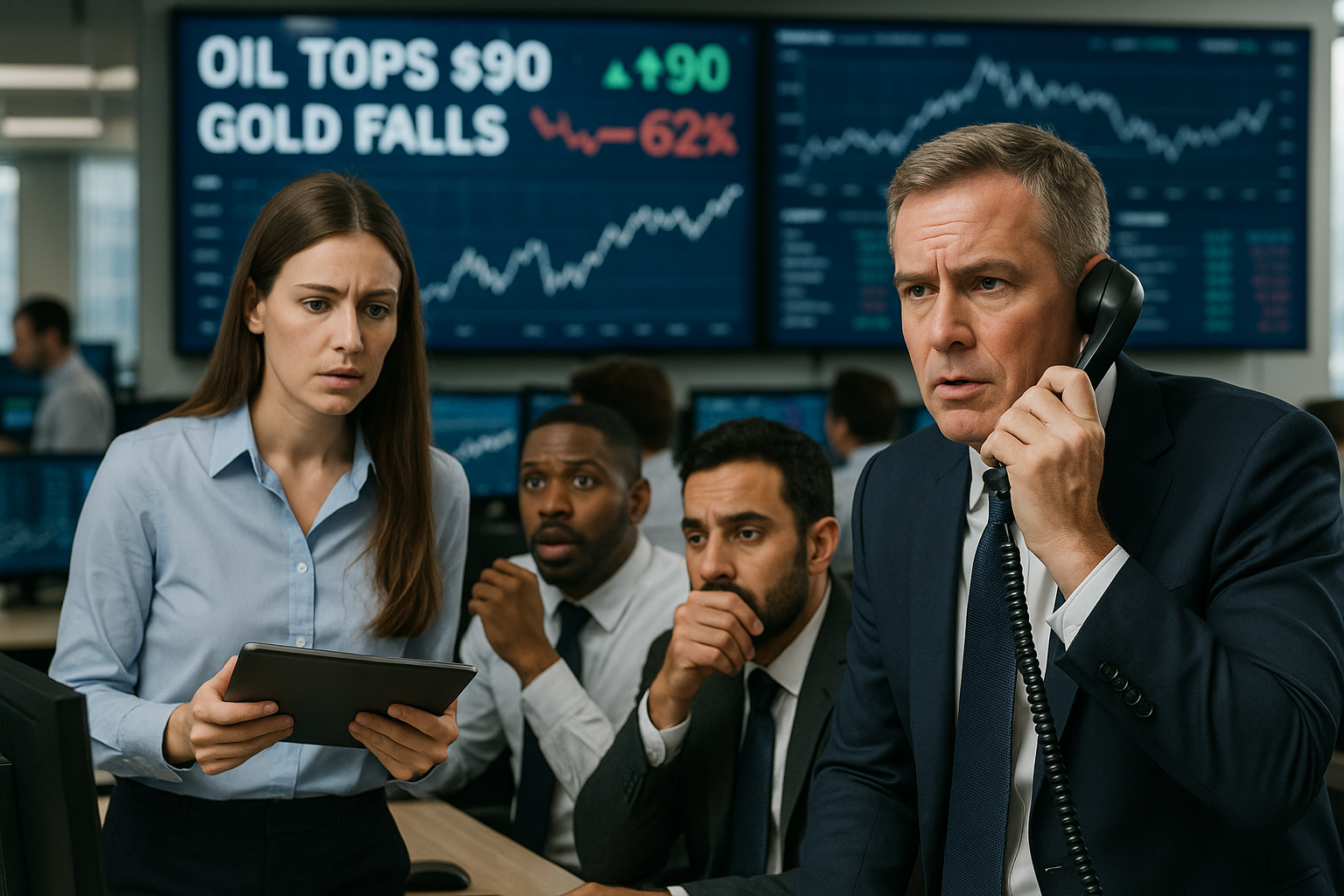
Monday delivered a rare split screen: a fresh US military strike in the Persian Gulf sent crude sharply higher, while gold — the asset that normally rallies hardest on exactly that kind of headline — fell instead. The reason is the Federal Reserve.
The Strike
US forces hit Iranian rocket launchers on Sunday that were preparing to deploy mines into the Strait of Hormuz, according to Captain Tim Hawkins, a spokesperson for US Central Command. It was the first significant exchange between the two countries in more than a month, ending weeks of relative calm in the waterway.
Crude reacted immediately. Brent for November settlement climbed above $90 a barrel, trading around $90.69 — a gain of roughly 2.9% on the day. West Texas Intermediate for October delivery rose 3.29% to $86.14. Despite the escalation, roughly 6 to 8 million barrels of crude are still moving through Hormuz daily, with no peace agreement in place between Washington and Tehran.
Gold Went the Wrong Way
Under normal conditions, a US strike on Iranian military assets guarding the world's most important oil chokepoint is a textbook bid for bullion. It did not happen.
Gold's spot price stood at $4,435.37 per ounce as of 9:00 a.m. ET Monday, down from $4,598.89 at the same hour Friday. That followed a brutal Friday session in which gold dropped 2.96% to $4,459 and silver slid 3.99% to $66.39. Silver December futures opened Monday at $66.80, down another 1.4% from Friday's close.
The culprit is rate expectations. Higher expected interest rates lift US real yields and the dollar, which raises the opportunity cost of holding metals that pay no yield and makes them costlier for overseas buyers. Right now that force is overwhelming the geopolitical bid.
Warsh Reset the September Trade
Fed Chair Kevin Warsh used his Jackson Hole keynote Friday to sharpen his inflation warning considerably. "We must be confident that underlying inflation is moving to our objective, clearly and at sufficient speed," he said. "Otherwise, we have work to do. That's our job, our mandate and our charge to keep."
He also made clear that the summer's softer inflation prints did not constitute "meaningful" improvement — a direct clarification of his more ambiguous messaging after the July meeting.
Markets repriced fast. Futures had put roughly a 35% chance on a hike at the September 16 FOMC meeting before Warsh spoke, according to CME's FedWatch tool. By Monday, odds of a 25 basis-point increase had climbed to about 62%.
"The Jackson Hole Symposium came with a hawkish Warsh, putting back into focus the September FOMC decision and the high risk of a rate raise at that meeting," said Kyle Rodda, senior financial market analyst at Capital.com.
Equities Caught in Between
Stocks absorbed both blows. The S&P 500 fell 0.44% to 7,677.54, the Dow Jones Industrial Average dropped 328.48 points, or 0.61%, to 53,231.51, and the Nasdaq Composite lost 0.42% to 26,290.66.
That leaves investors with an uncomfortable setup heading into the Labor Department's August jobs report on Friday: an oil shock pushing headline inflation up, and a Fed chair who has just told markets he is watching underlying inflation with visibly less patience. A hot payrolls number would make the September decision considerably less of a coin flip.
Sources: CNBC, Yahoo Finance, Bloomberg, The Washington Post, Trading Economics, Al Jazeera, TheStreet, Capital.com (via Yahoo Finance), CME FedWatch