
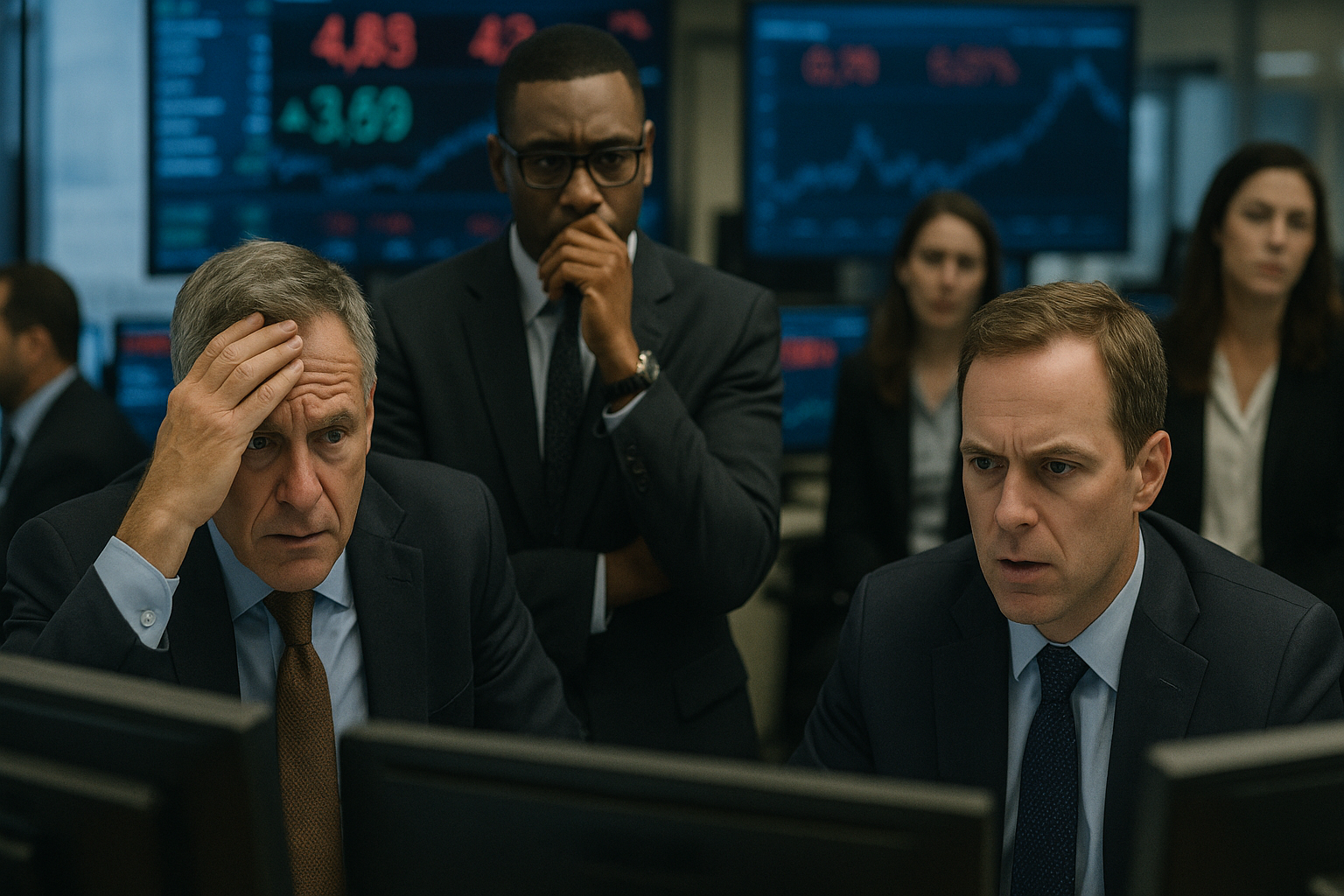
Treasury Secretary Scott Bessent tripled the size of the government's next bond buyback Wednesday. Yields went up anyway.
The Treasury said it would repurchase up to $6 billion of 10- to 20-year securities, three times the standard $2 billion operation. The intent was to put a lid on borrowing costs that have been climbing since Friday's payrolls surprise. Instead, the 10-year Treasury yield rose four basis points to 4.841% — its highest close since late 2023 — because Wall Street had been positioned for something considerably bigger. The 30-year added four basis points to 5.3%, back at the multiyear highs it set in August.
"Treasury announced buybacks less than hoped for — or feared, depending on your point of view," Mizuho economist Alex Pelle wrote, adding that Bessent is "facing an uphill battle, in terms of trying to move against the general momentum of the market." Peter Boockvar of The Boock Report noted that part of the market had braced for $7 billion to $8 billion. Mark Spindel, chief investment officer at Potomac River Capital, was blunter: "Hank Paulson's bazooka this is not."
Stocks Slid for a Second Straight Day
The Dow Jones Industrial Average fell 404.99 points, or 0.77%, to 52,381.08. The S&P 500 lost 37.03 points to 7,636.49, down 0.48%, and the Nasdaq Composite dropped 168.07 points, or 0.64%, to 26,253.34. Energy and utilities were the only sectors to finish higher; industrials and consumer cyclicals led the decline.
The pressure came from two directions. Higher long-term yields squeeze corporate margins and consumer demand, and the other force was crude. Brent climbed as high as $100.95 a barrel Wednesday, its strongest level since July, settling near $101, with West Texas Intermediate around $96. The catalyst was another round of U.S. strikes on Iranian oil tankers, on top of Houthi attacks that hit an alternative shipping route Saudi Arabia has leaned on to move oil during the war. Goldman Sachs has warned crude could reach $120 a barrel if the conflict escalates further.
Gold was essentially flat at $4,444.10, up 0.11%.
Meta Was the Exception
One large-cap stock ran the other way. Meta Platforms closed at $644.07, up 4.76%, after trading more than 6% higher during the session — the payoff investors have been demanding after several quarters of heavy AI capital spending. The company unveiled Muse, a standalone personal AI agent that can send emails, book travel and negotiate household bills on a user's behalf, available in the U.S. through its own app and inside WhatsApp.
Analysts moved quickly. KeyBanc kept a $780 price target and argued the market continues to "under-estimate Meta's AI positioning and product cycle," with Justin Patterson pointing to "engagement as the initial barometer of success, with monetization following." Mizuho's Lloyd Walmsley called it "a significant step" toward a return on Meta's infrastructure spend. Morgan Stanley's Brian Nowak flagged Meta's "broad-based distribution and rich consumer datasets" across Facebook, Instagram, WhatsApp and Messenger.
Apple, meanwhile, slipped as new chief executive John Ternus delivered his first keynote, introducing the foldable iPhone Duo alongside the iPhone 18 Pro lineup and Apple Watch Series 12.
Friday Is the Real Test
August CPI arrives at 8:30 a.m. Eastern on Friday, September 11 — the Fed's last inflation reading before next week's policy meeting. Economists expect headline CPI up 0.4% on the month and 3.4% year over year, with core at 0.4% and 2.4%.
Traders currently assign roughly a 60% probability to a 25-basis-point rate increase this month, according to CME Group data. With crude above $100 feeding directly into the energy component, a hot print would leave that number looking low.
Sources: Yahoo Finance, NBC News, CNBC, Quartz, Fortune, Investing.com, Benzinga, CME Group FedWatch