
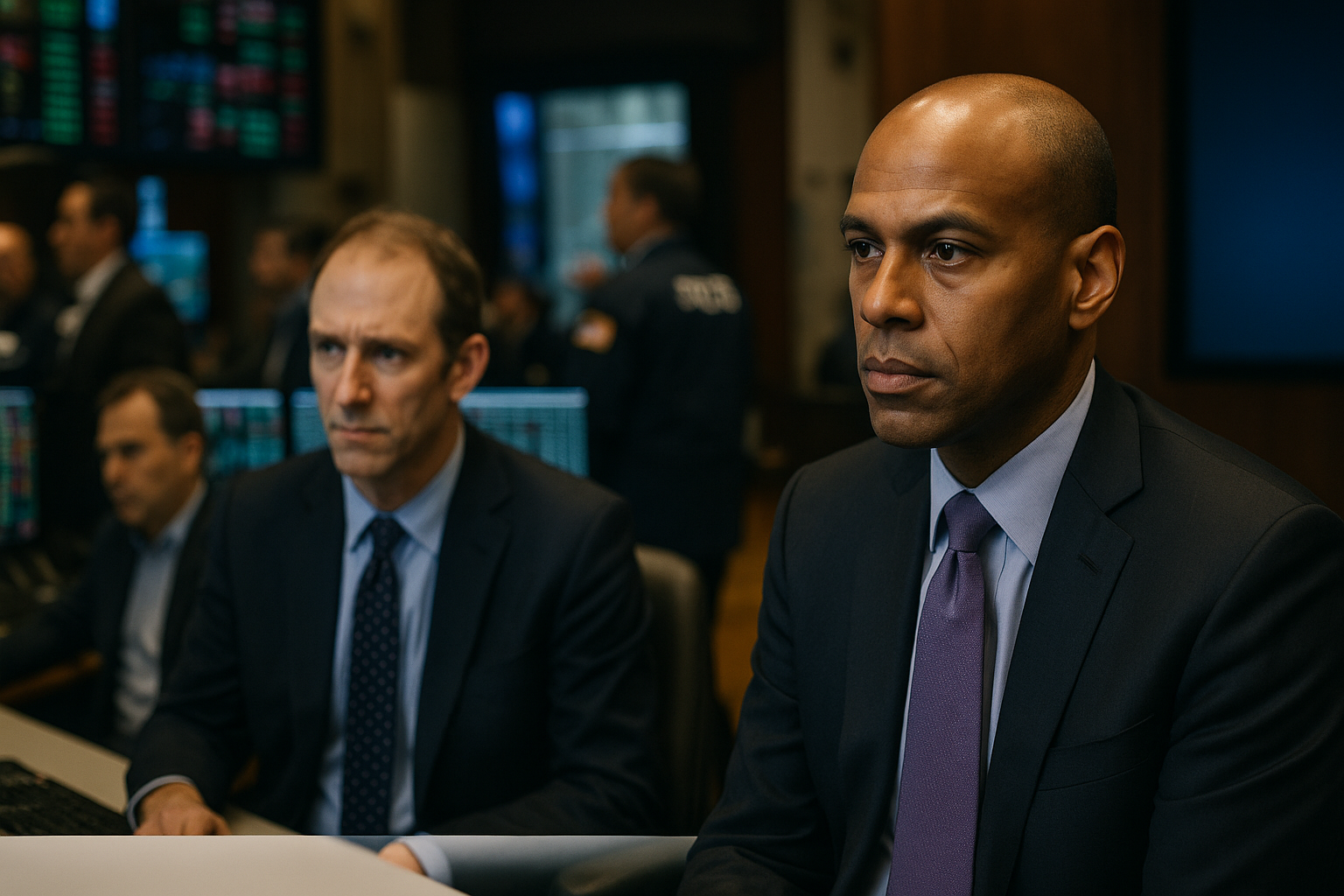
Wall Street opened the week with a relief rally as crude oil tumbled on fresh signs of US-Iran diplomacy — but the day's most consequential headline came from a Federal Reserve official standing at a podium in London, warning that the road back to 2% inflation is unlikely to be a gentle one.
Stocks Rally as Crude Slides
Equities pushed higher Monday, led by technology. The S&P 500 traded at 7,705.43, up 54.93 points or 0.72%, while the Nasdaq Composite jumped 1.23% to 26,847.61. The Dow Jones Industrial Average lagged with a 0.27% gain to 51,819.62, and the small-cap Russell 2000 added 0.43% to 2,872.57, according to Yahoo Finance market data.
The catalyst was energy. CNBC reported that US crude fell back below $100 per barrel after President Trump told Fox News he would probably be open to meeting Iranian President Masoud Pezeshkian at the United Nations General Assembly this week. West Texas Intermediate futures dropped roughly 2.7% to near $97.50, while Brent crude slid about 2.8% to approximately $101 a barrel. Qatar's prime minister added to the diplomatic thaw, saying messages were being exchanged between Washington and Tehran.
Falling energy prices pulled Treasury yields down with them. The 10-year note yield eased roughly four basis points to about 4.95%, retreating from the 5.01% level it reached Friday — the highest since 2023. Gold gave back ground in the risk-on session, slipping 0.84% to $4,387.60 an ounce, while silver held near $66 an ounce.
The Fed's Uncomfortable Message
The rally unfolded against a distinctly hawkish backdrop. Speaking at the Official Monetary and Financial Institutions Forum in London on Monday, Chicago Fed President Austan Goolsbee challenged the central bank's long-standing instinct to "look through" supply-driven price shocks.
Supply shocks, Goolsbee argued, "have come more frequently, hit harder and lasted longer." Pointing to oil, tariffs and commodities, he noted that "forecasters have spent more than a year pushing back the date when inflation was supposed to peak and start falling," adding pointedly: "That's not a comforting pattern."
His conclusion offered markets little comfort either. When persistent supply pressures keep inflation above target, Goolsbee said, policymakers cannot simply wait them out — "in environments like that, the only way back is the hard way," meaning higher interest rates and the growth and employment risks that come with them.
Goolsbee also flagged a newer concern: that surging AI data-center investment could push aggregate demand beyond the economy's capacity to supply it. If demand overheats, he said, "there is no ambiguity about how the Fed needs to respond." Goolsbee is not an FOMC voter this year.
Context: A Central Bank Already Tightening
The remarks follow last Wednesday's FOMC decision, in which the Fed raised its target range by 25 basis points to 3.75%–4.00% — its first hike since 2023 — in a unanimous vote. Updated projections placed the funds rate at 4.00%–4.25% by year-end, implying one more increase in 2026, with core PCE inflation for the year marked up to 3.4%.
Attention now turns to Thursday's Trump-Xi summit, where tariff extensions and AI cooperation top the agenda. Treasury Secretary Scott Bessent described preparatory talks as "very successful" and floated a US-China AI dialogue mechanism.
Market data reflects intraday trading on Monday, September 21, 2026.
Sources: Yahoo Finance (market data and live coverage), CNBC (oil prices and US-Iran diplomacy), Bloomberg ("Fed's Goolsbee Says Road to 2% Inflation May Not Be Painless"), Reuters via syndicated coverage of Goolsbee's OMFIF London remarks, Trading Economics (Treasury yields, FOMC decision and projections), Charles Schwab (FOMC vote detail).