
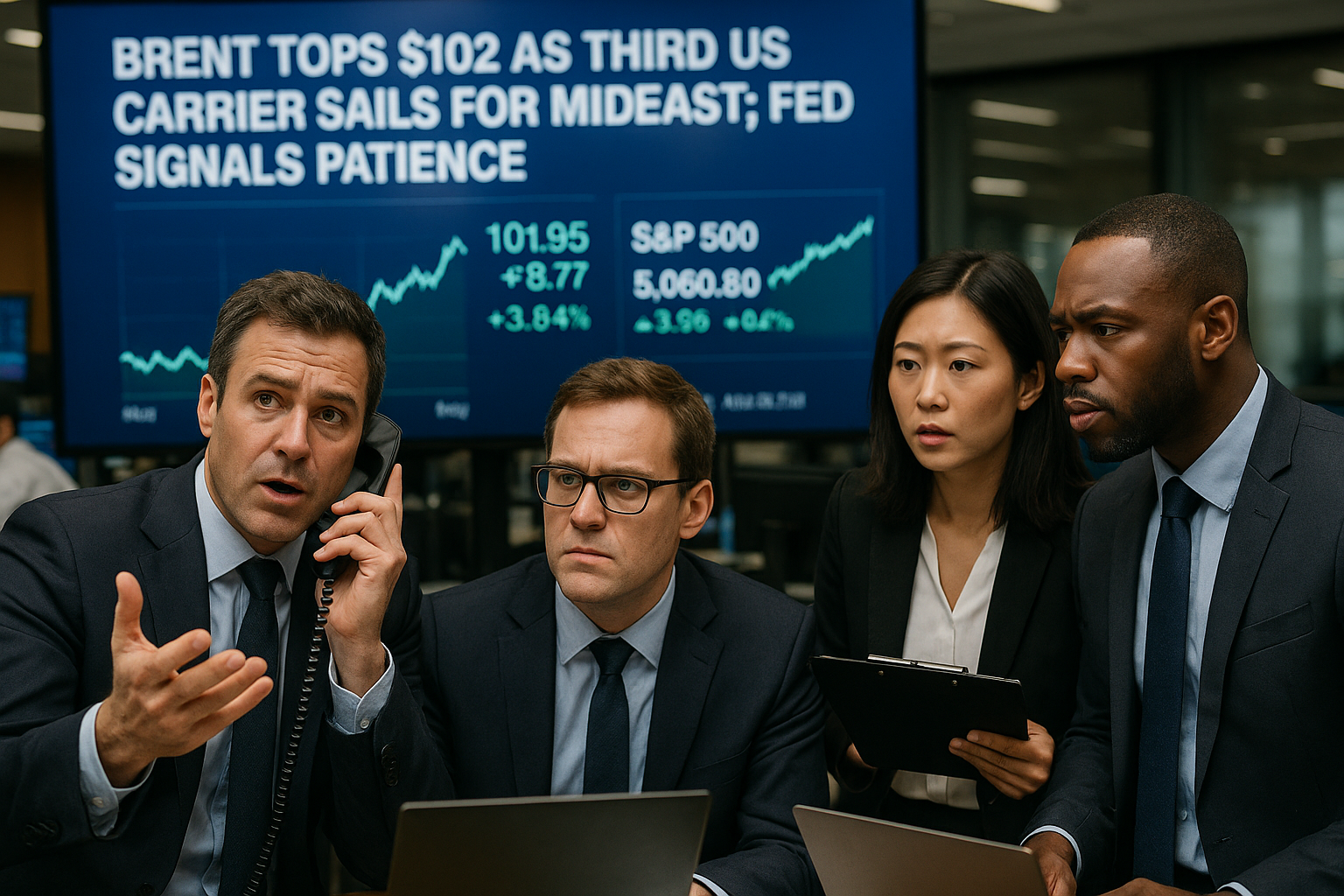
The fourth quarter opened with the two forces that have defined 2026 markets colliding on the same afternoon: a widening military buildup in the Persian Gulf and a Federal Reserve that cannot decide what to do about the inflation it produces.
Crude oil surged Thursday after reports that the United States is sending a third aircraft carrier strike group to the Middle East. Brent crude, the international benchmark, settled 4.4% higher at $102.31 a barrel, while U.S. West Texas Intermediate futures climbed 2.7% to settle at $92.87, according to CNBC.
A Third Carrier Changes the Calculus
The USS Theodore Roosevelt, a Nimitz-class nuclear-powered carrier, is en route to Central Command's area of operations along with its escort ships, The National reported. A separate amphibious group carrying more than 2,000 Marines has also departed for the region. U.S. officials told the Wall Street Journal the Roosevelt strike group will arrive by the end of November.
Two carriers are already on station — the USS George H.W. Bush and the USS George Washington, the latter deployed since August. The Roosevelt is expected to relieve the Washington, which is homeported in Japan, but the overlap gives Washington a concentration of naval airpower that traders read as preparation for escalation rather than routine rotation.
For the oil market, the arithmetic is straightforward. Roughly a fifth of global seaborne crude moves through the Strait of Hormuz, and every incremental signal of a wider U.S.-Iran conflict rebuilds the war premium that has kept Brent above $90 for much of the year.
Jefferson: Energy Is the Problem
Hours earlier, Fed Vice Chair Philip Jefferson gave a speech at the University of Virginia's Darden School of Business that explained why a $102 Brent print matters for interest rates.
"The predominant factor driving the recent pickup in headline inflation is energy prices," Jefferson said. The 12-month change in the personal consumption expenditures price index was 3.4% in August, he noted, and inflation "has remained above our 2 percent target for more than five years." His stated worry is "higher energy prices leading to a persistent rise in inflation more broadly" — the pass-through that turns a geopolitical shock into a monetary problem.
Jefferson described the labor market as near maximum employment, citing an unemployment rate that "ticked down to 4.1 percent in August" and a job-vacancies-to-unemployed ratio back above 1. On the bond market, he observed that "yields across the term structure have increased further," a sign that "investors are reassessing the evolving macroeconomic landscape."
He offered no commitment on timing. "Any future adjustments in policy should be determined by carefully examining trends in the data, the evolving outlook, and the balance of risks," he said, adding that "my colleagues and I will need to come to our own judgment, which may take more time."
Stocks Shrug, Bonds Catch a Break
Equities finished marginally higher despite the oil spike. The S&P 500 closed up 0.20% at 7,666.68, the Dow Jones Industrial Average added 0.04% to 50,927.33, the Nasdaq Composite gained 0.04% to 26,871.60 and the Russell 2000 rose 0.38% to 2,807.59, per Yahoo Finance.
The Treasury market got relief after a brutal quarter. The 10-year yield eased to 5.24% after touching 5.34% earlier in the session — its highest since 2002. Gold settled 0.51% higher at $4,208.10 an ounce.
Rate futures still lean toward waiting. CME FedWatch pricing put the odds of an October hike near 35% after Wednesday's softer core PCE reading, down from above 70% a week earlier, with traders pushing the next increase to December and the probability of at least one hike by year-end near 90%. A sustained move above $100 Brent would test that patience quickly.
Sources: CNBC, The National, Wall Street Journal, Federal Reserve Board (Vice Chair Jefferson speech, Oct. 1, 2026), Reuters, Yahoo Finance, CME FedWatch