
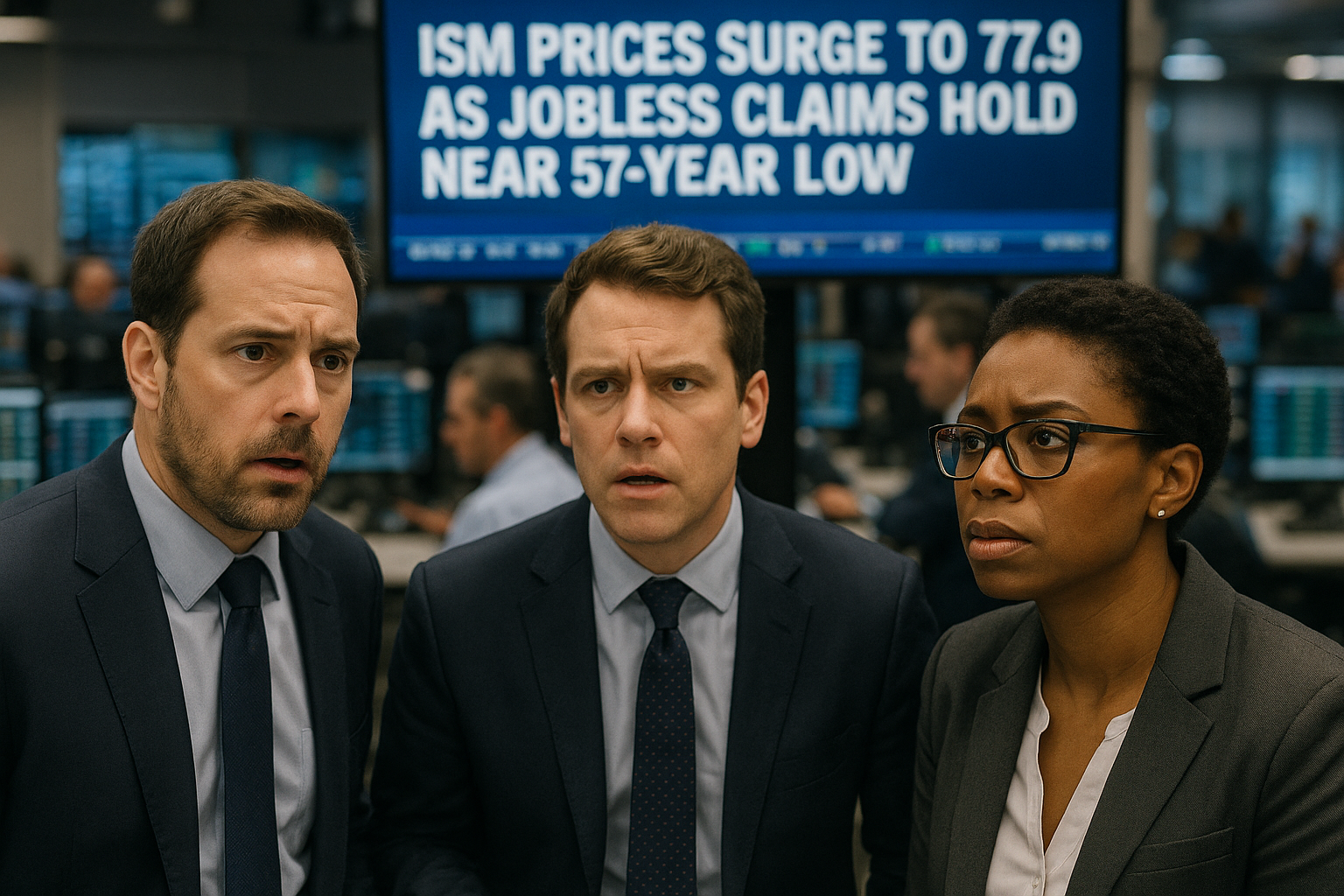
The fourth quarter opened with the worst possible combination for a Federal Reserve already debating another rate increase: factory input costs accelerating sharply while the labor market refuses to crack.
The Institute for Supply Management said Thursday its manufacturing prices paid index jumped to 77.9 in September from 71.1 in August — a 6.8-point surge that blew past forecasts near 72 and left the gauge far above its 2003-2026 average of roughly 61. Readings above 50 signal rising costs, and the index has now moved decisively into territory that historically precedes consumer-price pressure.
The headline ISM Manufacturing PMI itself was unremarkable, slipping to 54.5 from 54.6 and missing expectations of 54.8. But the composition mattered more than the top line. New orders climbed to 55.3 from 53.7 and the employment index rose to 52.7 from 51.2, indicating factories are hiring and taking orders even as they absorb steeper costs for energy and materials.
Claims Fall Again as Layoffs Dry Up
The labor data pointed the same direction. Initial claims for state unemployment benefits slipped 1,000 to a seasonally adjusted 197,000 for the week ended September 26, the Labor Department reported, keeping applications in a range not seen since the late 1960s. Continuing claims fell 11,000 to 1.701 million for the week ended September 19.
Separately, Challenger, Gray & Christmas reported employers announced 43,281 job cuts in September, down 20% from a year earlier.
"Companies are in a wait-and-see period right now," said Andy Challenger of Challenger, Gray & Christmas. "Employers are facing high energy costs, an uncertain war in Iran, a rate hike that could make hiring more expensive, plus the likelihood of surging healthcare costs."
Economists flagged the cost squeeze as a risk that has not yet bitten. "At some point, elevated energy costs and material prices will force firms to lay off marginal workers to protect profit margins, but there is no sign of that here," said Carl Weinberg of High Frequency Economics. Stephen Stanley of Santander US Capital Markets added: "We do not appear to be close to that result yet, but this is a new risk that the FOMC appears to be watching."
Bonds Take the Hit
The Treasury market absorbed the data poorly. The 10-year yield rose about three basis points to 5.32% and touched 5.34% intraday — its highest level since 2002 — following a quarter that ranked among the worst for government bonds in decades.
Equities drifted lower in Thursday trading. The Dow Jones Industrial Average slipped 0.51% to 50,646.50, the S&P 500 eased 0.29% to 7,629.51 and the Nasdaq Composite held up better at 26,818.00, down 0.16%, cushioned by semiconductors.
Micron supplied that cushion. The memory maker posted fiscal fourth-quarter earnings of $33.42 per share on revenue of $54.23 billion, against estimates of $31.83 and $51.49 billion, and raised its first-quarter outlook. "The expectations were already very high, so the fact that they can still exceed them" underscores the depth of memory demand, said D.A. Davidson analyst Gil Luria.
October Still a Coin Flip
Rate futures have swung hard in recent weeks. CME FedWatch pricing for a hike at the October 27-28 meeting sat near 47% as of Wednesday, down from above 70% in late September after New York Fed President John Williams signaled no urgency to move. Traders remain far more confident a hike lands before year-end, with December priced around 74%.
Friday's September employment report is the next hurdle.
Sources: Institute for Supply Management (via Trading Economics and Investing.com economic calendar), U.S. Department of Labor weekly claims report, Reuters, Challenger, Gray & Christmas, Yahoo Finance market coverage, CME FedWatch.